The GitHub Token Is What Got Burned at 1Password, Not the Vaults
1Password says an attacker used a compromised employee GitHub account to reach source code and CI/CD and push malicious backend code. Vaults were untouched. Here is what backend teams should take from it.
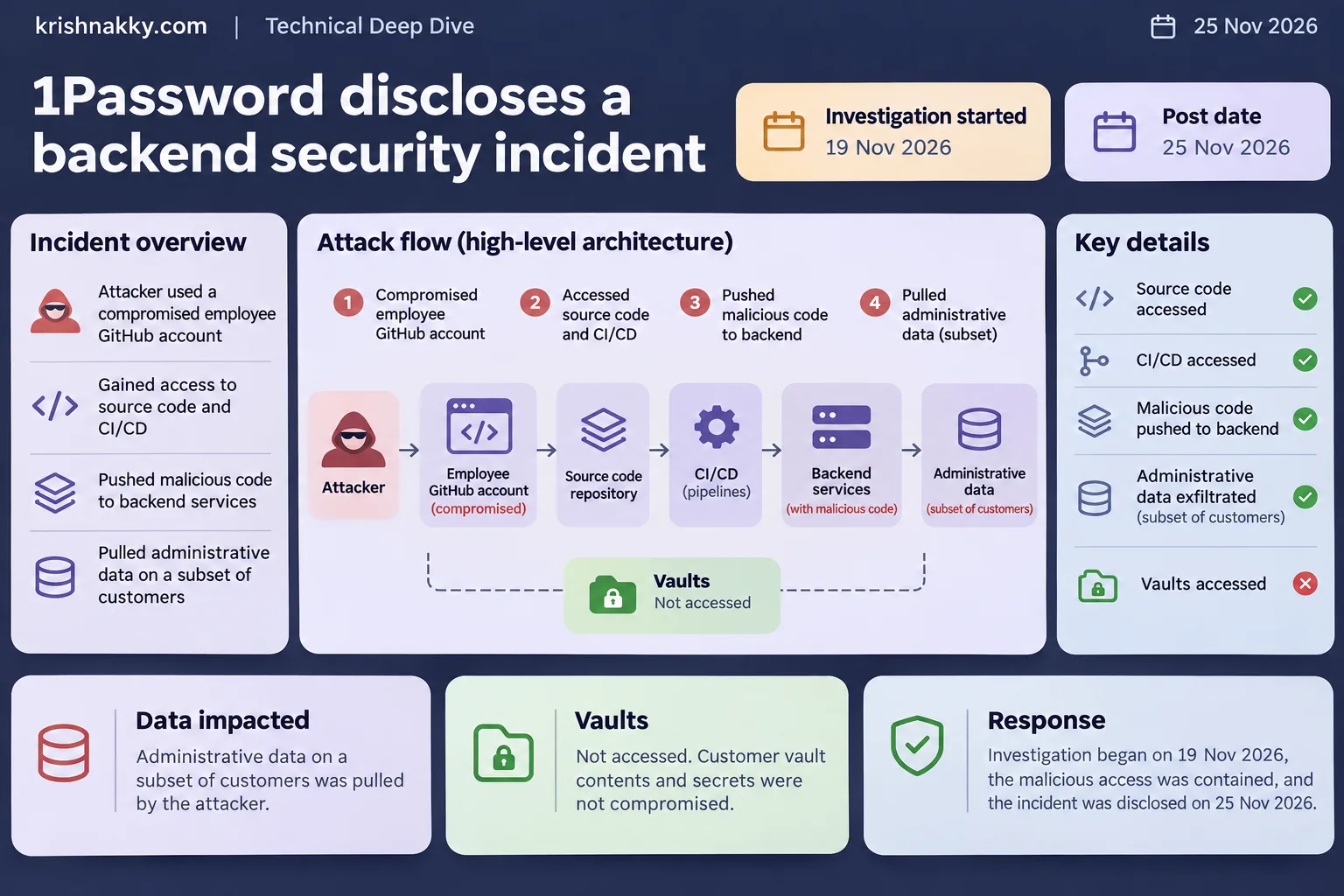
1Password disclosed a backend security incident: an attacker used a compromised employee GitHub account to reach source code and CI/CD, pushed malicious code to backend services, and pulled administrative data on a subset of customers. Vaults were not accessed. Their investigation began on 19 November 2026.
I'll say upfront what I can't tell you. The write-up doesn't say when the attacker first got in or how the account was compromised. I'm not going to guess, and you shouldn't trust anyone who does.
The vaults were safe, but the delivery path wasn't
The encryption design did its job. The thing people trust 1Password with was not the thing that failed.
What failed is the part most of us treat as plumbing. One employee's GitHub identity opened source access, then CI/CD access, then the ability to ship code into backend services. The attacker didn't need to break the cryptography. They borrowed the company's own delivery machinery.
My read: a developer's GitHub token is a production credential. If it can push to a branch that deploys, it carries the same power as whatever that branch deploys to. Plenty of teams still file it under "dev tooling" and give it a fraction of the care a database password gets.
What malicious backend code can do
The disclosure says malicious code was pushed to backend services and administrative data was pulled. It doesn't describe the code. What follows is my inference, not reported fact.
Code running inside a backend service inherits everything that service can touch: its database credentials, its outbound network access, and every request it handles in plaintext after TLS terminates. So the attacker's reach was bounded by those service permissions, not by the vault design. That is why least-privilege on the service account, egress allow-lists, and separate credentials per service matter more here than another round of encryption.
Tokens were taken from the backend, not from inboxes
The detail I found most telling is in the support notes. Tokens in invitation and recovery emails were part of what leaked, and 1Password lengthened them from 6 digits to 10 alphanumeric characters.
Note the direction of the leak. These were exfiltrated from the backend, not intercepted from anyone's mailbox. A longer token resists guessing, but it does nothing if the attacker can read the token at the source. No published source says how long these tokens lived or whether they could be reused, so I won't claim they were weak by design. The open question for your own system is what a token store looks like once an attacker has code execution next to it. Hashing tokens at rest, short expiry and single use are the controls that still help in that case.
"Vaults untouched" doesn't mean "no harm"
Zero-knowledge design means the attacker gets nothing decryptable. But administrative data like emails, SRP parameters, sign-in times and public keys is useful to a phisher. They know who your users are, when they're active, and which service to impersonate.
1Password itself warns about phishing. The blast radius of a breach is not only what's decrypted. It's also what makes the next attack cheaper. Check the status page for updates rather than relying on forwarded summaries.
What backend teams should check this week
The incident is about one stolen identity reaching deploy rights, so start there:
- List every token and deploy key that can push to a branch your pipeline deploys. Delete what nobody can explain.
- Require review and signed commits on deploy branches, so one stolen GitHub login can't both write code and release it.
- Move pipelines to short-lived OIDC credentials instead of stored keys.
- Alert on pushes to backend repos from new sessions, odd hours or unfamiliar committers.
- Hash invite and recovery tokens at rest and give them a short TTL and single use.
If your services are Spring Boot or anything else, the same logic applies: the pipeline decides what runs in production. Treat every developer token as a production key from today, because attackers already do.