Aaronson on AI Proofs and Lean Certificates: Verify AI Code Too
Scott Aaronson says he assumes OpenAI and Anthropic proofs are correct because they ship machine-checkable Lean certificates. Backend teams should hold AI-written code to a similar standard and treat possible crypto results as a crypto-agility drill.
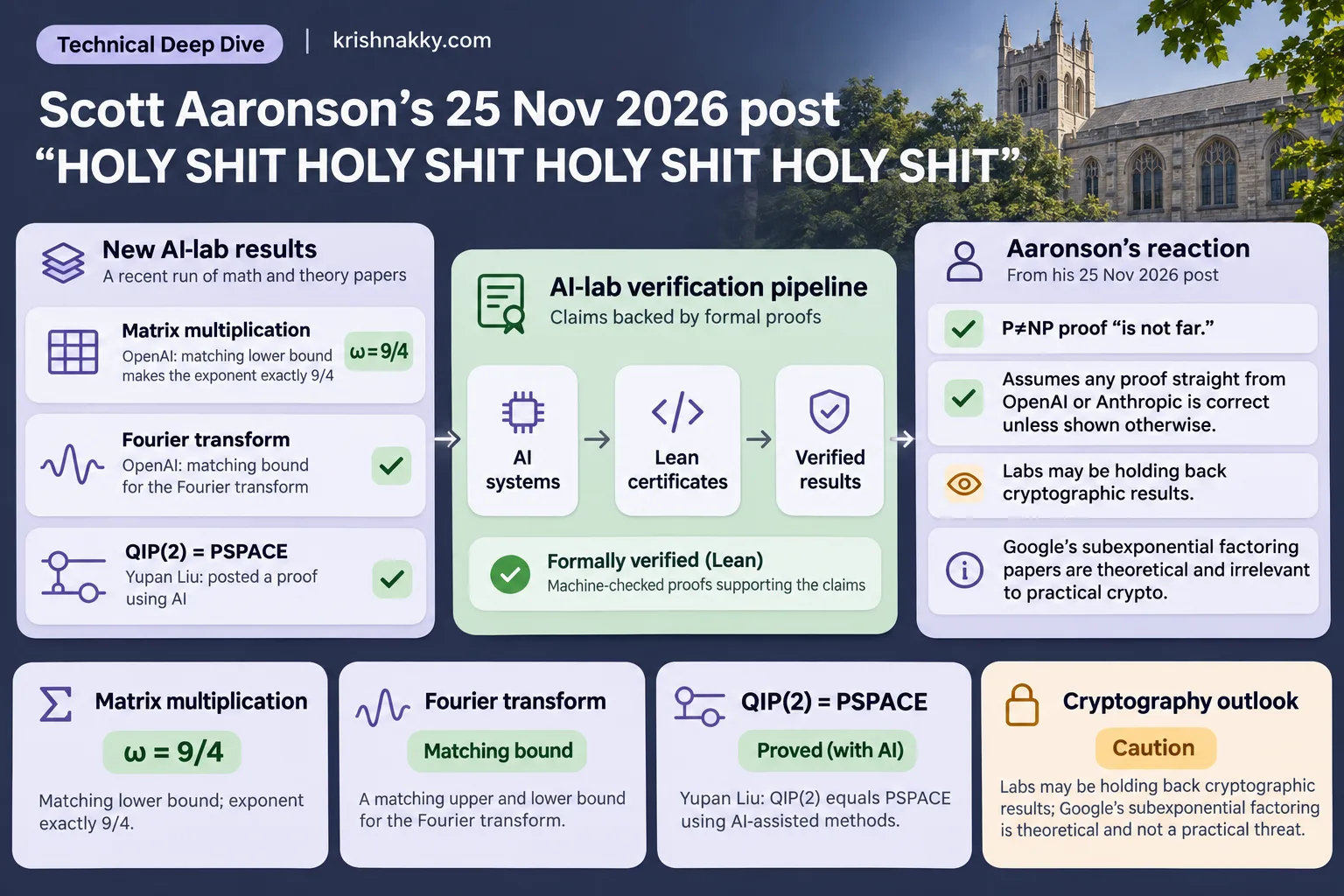
Scott Aaronson's 25 Nov post, titled with four "HOLY SHIT"s, reacts to a burst of AI-lab theory results. OpenAI posted papers on the matrix multiplication exponent and the Fourier transform, and a QIP(2)=PSPACE paper is said to be AI-assisted. Coverage also describes Lean-certified VP≠VNP proofs from both Anthropic and OpenAI, reported as released 23 Nov. That is arguably what set off his reaction. On P≠NP, the coverage I found says he only moved his confidence from 95% to 96%.
I'm skipping the math. I covered the matrix result already, and I can't referee any of this. Nobody independent has yet, so treat every claim here as unreviewed. I also could not confirm that the matrix paper proves a matching Θ bound. What I found was an upper bound plus a lower bound in a restricted formal-circuit model.
The sentence that matters to me
Aaronson says he assumes a proof coming straight from OpenAI or Anthropic is right unless shown otherwise. His reason, as he tells it, is not the brand. It's that the labs attach Lean certificates, so a machine has already checked the steps. I haven't verified that against the papers, so it's his reported claim, not something I confirmed.
There is a limit on how far that goes. OpenAI's README says its Lean formalization covers only division-free circuits computing formal polynomial identities over every field. It does not certify the full Θ(n^2.25) claim as the headline presents it. A certificate is only as broad as the statement it checks.
The principle still holds up: trust the checker, not the author. He is saying he doesn't need to trust the vendor, he needs a checker that doesn't care who wrote the proof.
Production code deserves a checker too
Most backend teams do the opposite with AI output. A model writes a patch, a migration or a retry rewrite, a human skims it, and the implicit evidence is "it looked right and the model sounded sure." That's trust in the author.
Nothing in a normal CI pipeline matches a Lean proof. Property tests sample inputs and can miss the one case that breaks you. But they are a real step up from example tests, and you can ask for these alongside any machine-written change:
- Property-based tests that state the invariant, not just examples that happen to pass.
- An executable spec, or a formal one where it's worth the cost, for the things that must never break: ledger entries summing to zero, settlement being idempotent, an order never filling past its limit.
- Reproducible builds, so the binary you run is the thing CI checked. This covers provenance, not correctness.
- Migrations that ship with a verifiable before-and-after check, not a promise.
The November outage cluster is the lesson from the failure side: fast, confident patches without a check are how a bad hour becomes a bad week.
The AI can write the property tests and the spec too. The rule is that CI, not the author, gets the final vote. Lean works for Aaronson because the checker is small and simple. Make yours the same.
The crypto half: don't panic, don't ignore it
Aaronson also suggests the labs may be sitting on cryptographic results. That's a rumor on top of an unreviewed claim. His own comments, as reported, call Google's subexponential factoring papers theoretical and irrelevant to practical crypto. So panic is wrong.
Ignoring it is wrong too, for a boring reason: the work you'd do if the rumor were true is work you should already be doing. I'd want these in place regardless:
- An algorithm inventory. Where do RSA, ECDSA and DH actually live: TLS terminators, JWT signing, HSM integrations, market-data feeds, partner mTLS, file signing?
- Key-rotation runbooks that someone has actually executed, not just written.
- Signing and TLS paths that can swap algorithms through configuration, with a post-quantum hybrid option tested in staging.
Payment rails and market-data links are the hard cases, because the other side's cert chain and library version limit you. Find out which partners can't move before you need them to.
My position
Put checkers between AI output and production, and make your cryptography replaceable before anyone gives you a reason. Both cost less now than they will after a surprise.