OpenAI's FFT Lower Bound Claim: What Aaronson's 'Holy Shit' Post Means for Backend Engineers
OpenAI preprints claim a matching FFT lower bound, per Scott Aaronson. Why Lean certificates work like a CI gate, and why no hot path should change yet.
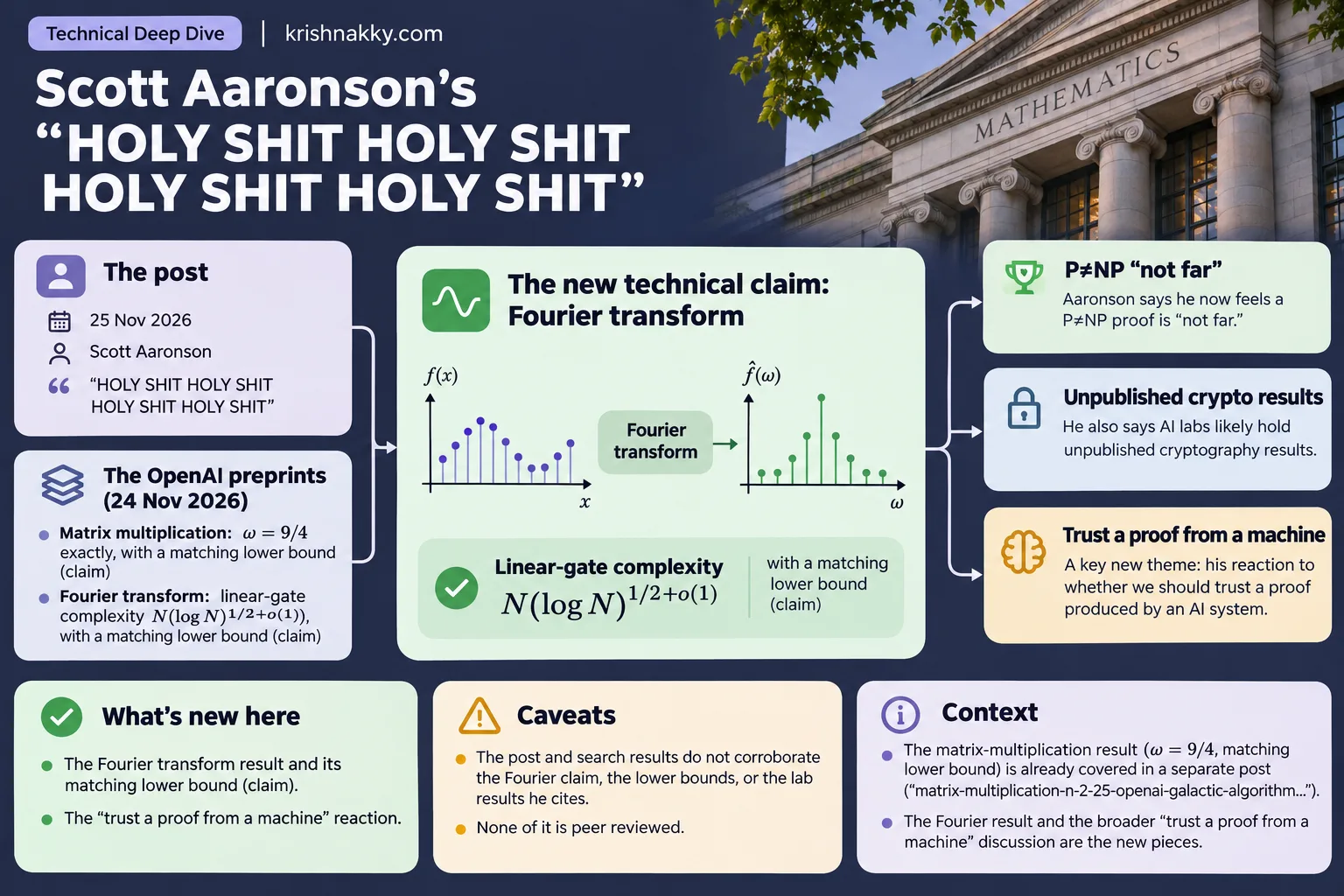
Scott Aaronson titled a blog post with four repetitions of "holy shit" after OpenAI released two preprints on 24 November. One claims the matrix multiplication exponent is exactly 9/4. The other claims the Fourier transform needs about N(log N)^(1/2+o(1)) linear gates, with a matching lower bound. I'll skip the matrix half, since I already wrote about it.
I couldn't open the PDFs, so I haven't read either proof. Secondary coverage of the Fourier claim exists, including reports that the log exponent is halved, but none of it is peer reviewed and I can't check the details. So I won't judge the mathematics. What I can judge is the verification story, because that is the part that looks familiar.
The Lean certificate is just a CI gate
Aaronson says he assumes proofs from OpenAI or Anthropic are correct when they ship Lean certificates. I think that is a sound instinct, and it's the same one I have about a green pipeline. A reviewer doesn't re-derive every line when the type checker has already accepted it. Machine-checked evidence beats reputation. A famous author with no certificate gets less trust than an unknown author with one.
But a passing gate only tells you the code matches the tests. It doesn't tell you the tests ask the right question. A payments service can ship green while no test ever covered a retried webhook posting twice; the pipeline was right and the question was wrong. The same applies here. Lean can confirm that a theorem follows from its axioms. It can't confirm that the theorem as formalized is the thing the press release says it is. "Linear gates" is a specific circuit model. A lower bound inside that model is a statement about that model, not about the FFT you run on a CPU.
So the human work moves to reading the formal statement. That is a smaller job than checking a proof, but it's still a job, and it's the one people will skip because the green checkmark feels like an answer.
What it changes in my services: nothing, yet
FFT libraries such as FFTW or JTransforms sit behind spectral features in quant research and some market data work. Even so, a claimed asymptotic improvement doesn't change a single deployment until someone benchmarks it on real data with real cache behaviour. Constants, memory access patterns and vectorization decide FFT speed in practice, not exponents. Asymptotic results like this usually only pay off at sizes far beyond anything I run, so I'd treat speed as unmeasured until someone shows otherwise.
The claim also reportedly pairs the lower bound with a matching upper bound, which would mean a construction, not just a limit. But that construction lives in the linear-gate model. It is not a drop-in routine, and nobody has shown it running on a CPU.
The rumor part
Aaronson also says a P≠NP proof "is not far" and that AI labs likely hold unpublished cryptography results. I'm filing both under unverified rumor. The post says it, I can't check it, and nobody has shown me anything. If you build on cryptography, that is a reason to keep your algorithms swappable. It isn't a reason to act on a feeling.
How I'd handle it
I handle a "holy shit" claim like a vendor's release notes: read it, note it, and wait for someone independent to replicate it. Then check what the formal statement actually covers. Then ask whether it touches anything I operate. I would not rewrite a hot path for a bound I can't measure.
The primary sources are there if you want them: the Fourier preprint and the matrix multiplication preprint. If a Lean file ships with them and mathematicians outside OpenAI confirm the statements match the claims, that's when I'd take it seriously. Until then, my FFT code stays as it is. Trust the checker, then read what it checked.