AI Made Self-Hosting Cheap to Start, Not Cheap to Run
Jan-Lukas Else says AI agents made self-hosting fun again. My take: the first deploy got cheaper, running the service didn't, and Git-backed review keeps it safe.
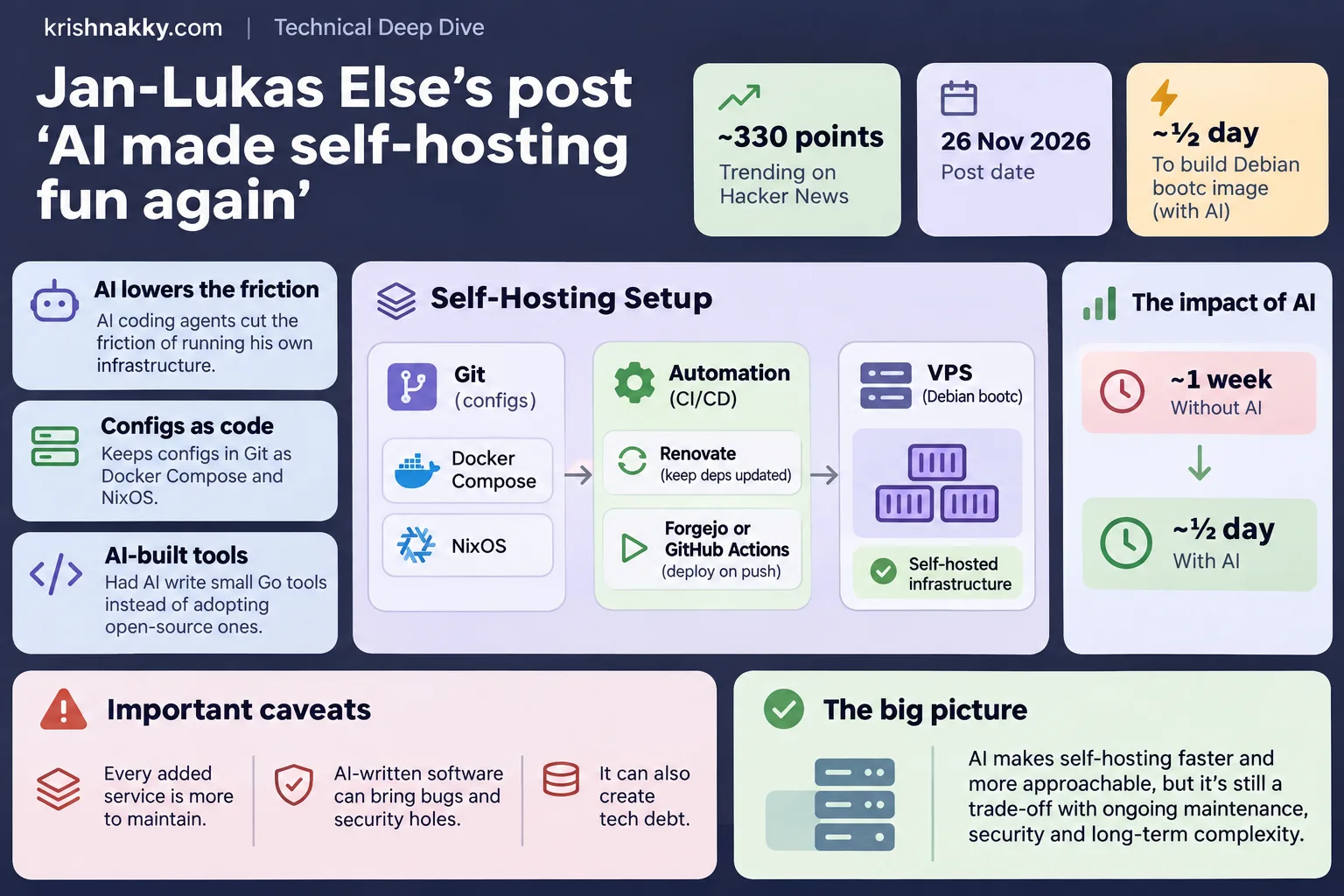
Jan-Lukas Else's post, AI made self-hosting fun again, is sitting at around 330 points on Hacker News. His claim is that coding agents removed the friction from running his own infrastructure. He built a Debian bootc image for his VPS in about half a day, which he says would have taken a week without AI.
I could not retrieve the post's text or the HN thread, so I'm working from the summary above, and my paraphrases of Else are my reading, not quotes. I like the premise, but the headline leaves out what happens after day one.
Cheap to start is not cheap to run
AI made the first deploy cheap. But in my experience writing the config was rarely the burden. The burden is what happens at 3 AM in month eleven: the disk is full, a certificate expired, a backup restore turns out never to have been tested, a secret leaked into a log, and you need to roll back a change you made while half asleep.
An agent can write a Compose file in two minutes, and the service it describes still needs patching, restore tests and someone to page.
What actually went up is the cost of deciding what to run. When adding a service takes ten minutes, the natural limit on your infrastructure disappears. In my experience friction works as a crude filter: if setup is painful, you only run what you really want. Remove it and you keep the pager duty for everything that slips through. As I read it, Else already accepts that every added service is more to maintain, so this is a difference of emphasis.
Why his setup holds up
The part I'd copy is not the AI. It's that everything lives in Git as declarative config: NixOS, bootc images, Compose files, Renovate opening update PRs. That matters because an agent's output becomes a diff. A diff can be read, tested, rejected and reverted. If the agent gets something wrong, the damage is a bad pull request, not a mystery on a running box.
My rule for backend teams is narrow. Let agents write infrastructure only when the result is reproducible and has to pass a human-reviewed PR before it touches anything live. If an agent can reach a production host and change it by hand, you have not adopted AI-assisted infrastructure, you have handed an unreviewed process a shell on production.
Push-to-deploy cuts both ways
Push-to-deploy is lovely until nobody understands the diff. I wrote about this in the November outage cluster and AI emergency patching: a fast path to production also speeds up a bad change when the reviewer approves something they can't explain. My worry, a judgment and not a measured result, is that large, tidy-looking agent diffs are easier to approve unread.
My own box
I run several live services on one VPS, including a crypto trading service that handles real money. My standing rule for the agent I use there: it may never stop, restart or redeploy that service, even to fix something that looks broken. Before and after any box-wide work it must confirm the service has the same PID and uptime. Anything that might touch it comes to me as a question first. It is plain change management, and it applies whether the config was typed by me or generated by a model.
What transfers, and what doesn't
This is a hobbyist, single-operator story, and it should be read that way. Else owns the whole system, accepts the risk himself, and has no compliance team, no on-call rotation, no customers and no audit trail to maintain. Plenty of what makes it pleasant disappears once five people share the blame for an outage. The declarative-plus-PR habit transfers fully. The "half a day instead of a week" speed-up transfers only partly, because in many companies I'd expect much of that week to go on approvals, access and agreeing on what should exist.
My position
Use agents to write infrastructure, but only into a repository, and only behind a review you'd be comfortable defending after an incident. "It was easy to deploy" is never a reason to run something. If you can't say who patches it, who restores it and who gets paged, don't run it, however fast the agent can build it.