Anthropic's ANT Debut: The IPO Plumbing Held, the Price Faded, and Your AI Vendor Is Now a Public Counterparty
Anthropic priced at $83 and opened near $111.50 on Nasdaq. A markets-infrastructure engineer on the opening cross, the day-one fade, and why 'AI provider' now belongs in your counterparty risk register.
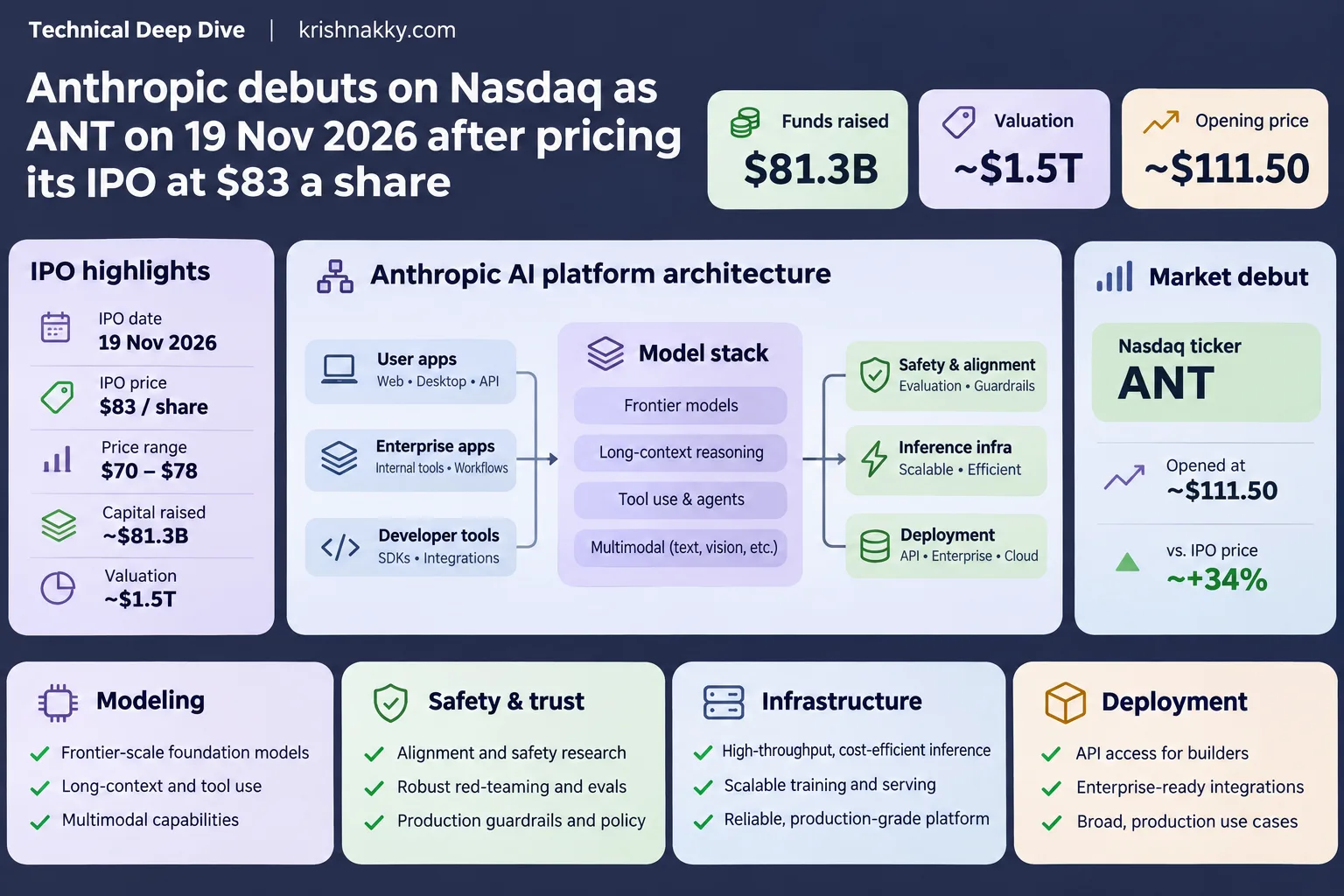
Anthropic began trading on Nasdaq as ANT on 19 November after pricing at $83, above its marketed $70-$78 range, per TechCrunch. TechRepublic has it opening at $111.50, about 34% up. Anthropic's release puts the offering at 980M shares at $83, a raise of about $81.3B.
Everyone is arguing about the valuation. I don't care. I've spent years near live order flow, and what I care about is what that opening print cost the machinery underneath.
The opening cross is the real stress test
A deal this size doesn't open like a normal stock. Months of retail and institutional demand collapse into one auction. Nasdaq-attributed coverage puts the opening auction at about 136M shares. The exchange had to take in that burst of indications, publish imbalance data fast enough to be useful, and then run a cross that thousands of downstream systems read at the same instant.
Then the fan-out starts. Market-data feeds spike. Retail brokers try to route orders into a name with no trading history and a wide, jumpy book. Volatility bands and halt logic get tested on a symbol where nobody has calibrated a reference price. A 34% pop is exactly the situation those guardrails exist for. I found no coverage of halts or volatility bands actually triggering, or of broker outages, so on the public record the cross held. What I'd still want to see is the imbalance feed's publication latency, which no outlet reported.
The stock did not hold the gain. It hit an intraday high near $115, then closed at $97.17, per CBS, CNN, CNBC and Yahoo, a slide of about $14 from the $111.50 open. Coverage then reports a 9% drop in early trading on Friday, and later closes below the $83 IPO price. An auction price and a continuous-market price are different animals, and anyone who has watched a book after an opening cross knows the first hour tells you more about the plumbing than the headline does.
Your vendor now has a disclosure calendar
Most commentary on the IPO stops at "diversify your AI vendors." That's true and also useless, because it reads like a procurement slogan.
Until this week, a foundation-model provider was a supplier with a roadmap. Now it's a public company with quarterly earnings, guidance, analyst models, and a share price that moves on gross margin. Its prospectus puts customer concentration and heavy reliance on cloud partners among the risk factors. I haven't tied those to specific figures here because the reporting on them is inconsistent, so read the filing, not the summary.
The pressure that follows is a risk to plan for, not a forecast. Margin targets can push on pricing tiers and rate limits, and deprecation timelines or free allowances can change. I have no example of a provider timing those to earnings, but a public company has the incentive. That's ordinary behavior once Wall Street is in the room, not malice.
What I'd do if Claude sat in my critical path
I run Spring Boot services where a dependency failing at the wrong minute costs real money. I treat the model API exactly like a market-data vendor or a clearing counterparty:
- Put one seam between your domain code and any model. Prompts, tool schemas, and output parsing should live behind your own interface, not scattered through business logic.
- Keep a second provider warm, not theoretical. A fallback you've never sent traffic through will fail the first time you need it. Route a small slice of real requests to it, and compare the outputs.
- Budget for price and quota shocks as an incident class. Cap spend per workflow, shed low-value calls first, and know which features degrade gracefully and which ones stop.
- Pin model versions and test on every change. A silent upgrade is a deploy you didn't approve.
- Read the first 10-Q. For a new registrant it is generally due within 45 days of the registration going effective, which points to early January 2027. Concentration, cloud-partner dependence, and capacity commitments tell you where the pricing pressure will come from before it reaches your invoice.
Where I land
The cross itself looks like it went fine, and the fade from $111.50 to $97.17 and below $83 afterward is the part that matters to a risk register. For anyone shipping fintech on top of a single model provider, the lesson is not "great company, buy the stock." It's that your vendor just acquired shareholders, and shareholders don't care about your SLA. Design as if the provider were a counterparty that can reprice, throttle, or retire a model on a quarter's notice, because from here on, it can.