AWS us-east-1 Went Down at the Login Door, and That's the Part Nobody Is Planning For
On 15 Nov 2026, us-east-1 broke IAM Identity Center sign-ins for 2-3 hours with no stated cause. A production engineer's take: identity is a tier-0 dependency, and your failover shouldn't need a console login.
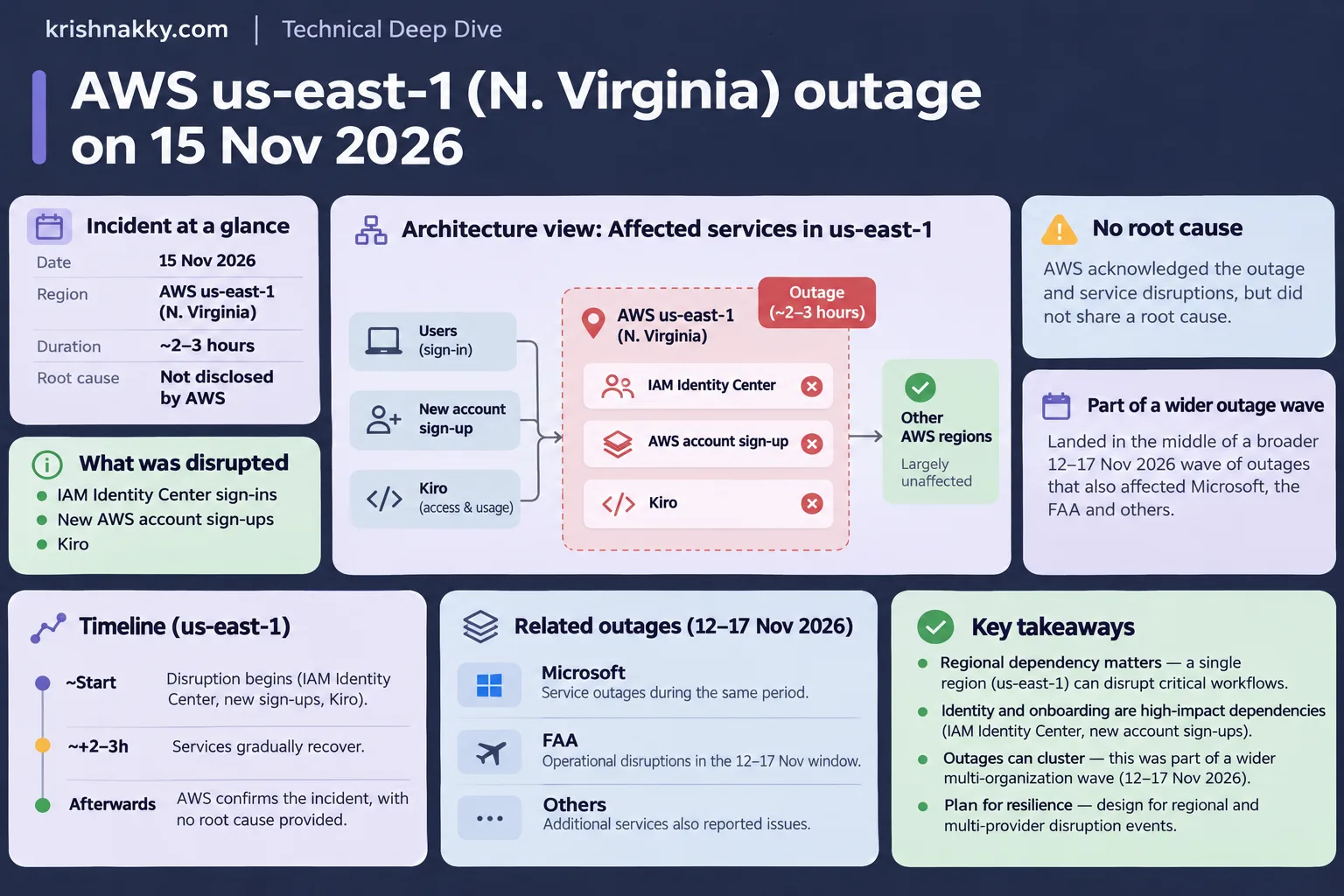
On 15 November, AWS's us-east-1 region had connectivity trouble that broke IAM Identity Center sign-ins and new account sign-ups, and it took Kiro's enterprise login with it. Status trackers logged it at a couple of hours, and other reports put it closer to three. The incident wasn't identity alone: the status entries also describe Network Load Balancer trouble in a single availability zone (use1-az1) and impact across 11 services, so Identity Center was the most visible casualty, not the only one. I haven't found a root cause anywhere.
Most of the coverage I read is about the outage. I care more about what kind of outage it was.
Compute wasn't the problem
Running instances kept running. What stopped was the front door. If you were mid-incident on something else and needed to get into the console through Identity Center to shift traffic, you couldn't. One report says AWS told customers there was no workaround. I'd treat that as reported, not confirmed, but even as a rumour it should scare you.
Notice that Kiro users who signed in with social login reportedly sailed through while the Identity Center users hit errors. Same product, same region, and the identity path you picked decided whether you had a bad afternoon.
Multi-region is a slide until you test it without the console
Failover plans usually say "promote the standby region." They rarely say who logs in, as what, from where, and what happens if the thing that issues that login lives in the region that's on fire.
Your standby region is useless if the people authorised to flip it are locked out by a control plane in the failing one. Resilience of the data plane and resilience of the human plane are separate properties, and we only test the first.
What I'd do on Monday
Treat identity as tier-0, in the same bucket as DNS and the network. Concretely:
- Keep break-glass credentials that don't depend on Identity Center, stored offline, rotated, and exercised on a schedule. A break-glass account you've never used is a rumour.
- Make cross-region failover runnable without a console session. A runbook that starts with "open the console" fails the moment sign-in does.
- Run a game day where Identity Center is declared dead and see who can still act. If nobody can, you've found the gap on your own schedule instead of AWS's.
Reading the November cluster without overclaiming
This landed inside a 12-17 November stretch of failures at Microsoft, the FAA and others, and TechRepublic's timeline lines them up neatly. To be fair, the Cloud Security Alliance note is careful here, and nothing public ties these incidents to a shared cause. I'm not claiming one.
What I'm offering is a framing, not a finding: the fragility may be correlated even if the causes aren't. Many teams concentrate on the same dependencies: one region, one identity provider, one auth path. Independent failures that land on the same hidden dependency look like a single failure from your side of the screen. I made a similar argument about vendor concentration in the Anthropic IPO piece, and the shape is the same here.
Why the silence matters
I can't say whether AWS reduced shared control-plane dependencies in us-east-1 after the 2025 DNS outage, because nothing public explains this one. Without a stated cause I can't tell whether my own design is exposed to the same fault, and a status entry doesn't answer that the way a post-mortem would.
My position: don't wait for AWS to be perfect. Design as if us-east-1 identity can fail again, since it just did. If your recovery plan needs a successful login to the region that's down, you don't have a recovery plan.