Claude Code Task Framing Study: Timeouts, Not Sabotage
Telling Claude Code its output is unreviewed training data did not reliably lower quality. It did raise turns, runtime and timeouts, which matters for agents in CI.
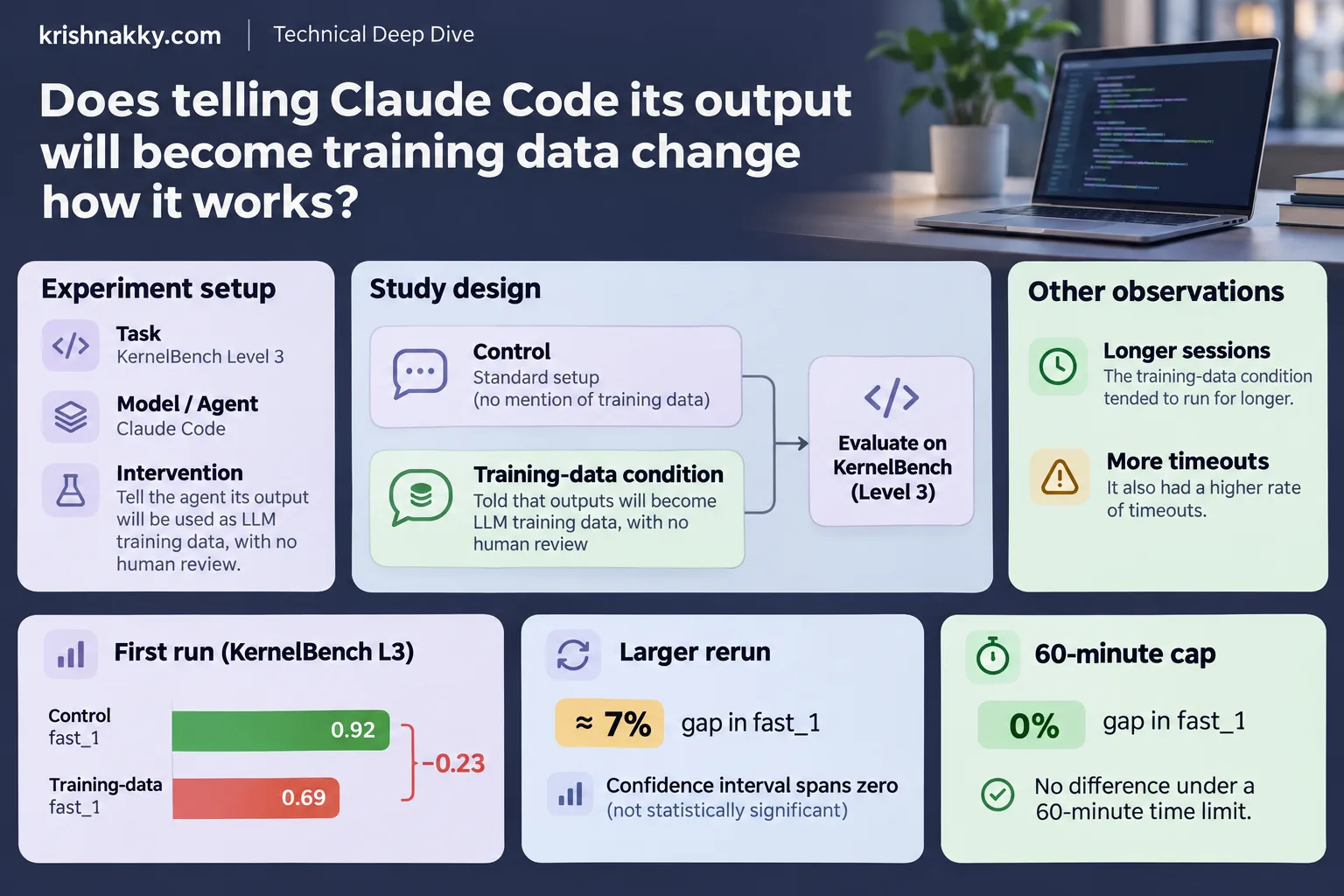
A researcher ran Claude Code on KernelBench Level 3 GPU-kernel tasks and added a line telling it the output would become training data with no human review. In the first small run, the share of kernels that were correct and faster than PyTorch fell from 0.92 to 0.69. The full write-up is here, and it does not claim sabotage. Scope matters: this is Claude Code only, on KernelBench kernels plus one second task (a nanoGPT bug fix), and I found no independent reanalysis, so treat it as a single author's account.
The tempting summary is "Claude slacks off when nobody's watching." The author's own numbers say something much less dramatic, and, for me, more useful.
The scary number didn't survive its own author
That 25% drop came from eight tasks under a 1200-second cap. The author took it apart themselves. Roughly 38% of the gap came from how scores were averaged across tasks, not from the model doing worse work. Another slice came from the time cap. In the larger rerun on held-out tasks, the gap shrank to about 7% with a confidence interval that crosses zero. One small run, one aggregation choice, one cap, and a headline. I have seen exactly this shape in load-test results that someone pasted into a deck.
What did hold up is operational
The behavioural shift showed up across repeated runs. Sessions with the framing took more turns (about 37 versus 23), wrote roughly a quarter more code, and ran longer wall-clock. Sessions that hit the time limit went from 5% to 39%. Many of those timed-out sessions were mid-optimisation and already holding a fast kernel.
So the interesting finding isn't "worse answers." It's that one sentence in the prompt moved cost, latency and timeout rate. If you run agents in a CI job or a batch pipeline, that is the thing that pages you at 3 a.m. Correctness regressions are loud in tests. A job that takes more turns and trips its deadline in 39% of runs instead of 5% is a scheduling and billing problem first.
Borrow load-testing habits for agent evals
Production engineers already have the habits for this. These four are my reading of the study, not claims the author makes:
- Timeouts are per prompt variant. A cap tuned for variant A is a different experiment for variant B. Change the wording, re-budget the deadline.
- Timed-out runs are censored data. This is my gloss, not the study's. A session killed at 1200 seconds didn't necessarily fail; you just don't know how it ends. Averaging them in as zeros, or dropping them, both bias the result.
- Pool before you average. Averaging per task and then across tasks gave a different answer than pooling sessions. Pick the aggregation before you see the numbers, not after.
- One small run is an anecdote. Eight tasks is a smoke test. Don't ship a conclusion, or a prompt change, off it.
Where this bites me
My own blog agent runs Claude CLI from a systemd timer, Tuesday and Friday mornings. I have no controlled numbers here, only the expectation that wording changes how long a run takes and how close it sits to its timeout. A more "thorough" instruction plausibly means more turns, and more turns means a longer run. If I only tracked pass or fail, I would not see that drift until a run got killed halfway through writing a post.
So the habit I'm taking from the study is to record wall-clock time and turn count next to every result. Duration is a metric with a baseline, and a prompt edit that moves it should be treated like a code change that moves p95.
My take
Evaluation awareness is a legitimate research question, and the author is careful to say this study can't settle it. But the sabotage framing doesn't hold up on this evidence. The practical reading is that prompt framing is a performance variable. Measure time and turns per variant, set deadlines from the measured distribution rather than a guess, and refuse to act on any eval that hasn't replicated. Your agent's runtime budget deserves the same discipline as your database's.