Dreamteam's $53M Bet: An AI Agent Can Write the CRM Notes, but Who Owns the Record?
Ex-Freshworks founders raised $53M from Together Fund, Accel and Premji Invest to build an AI-native CRM against Salesforce and HubSpot. A production engineer's take on why the system of record is the hard part.
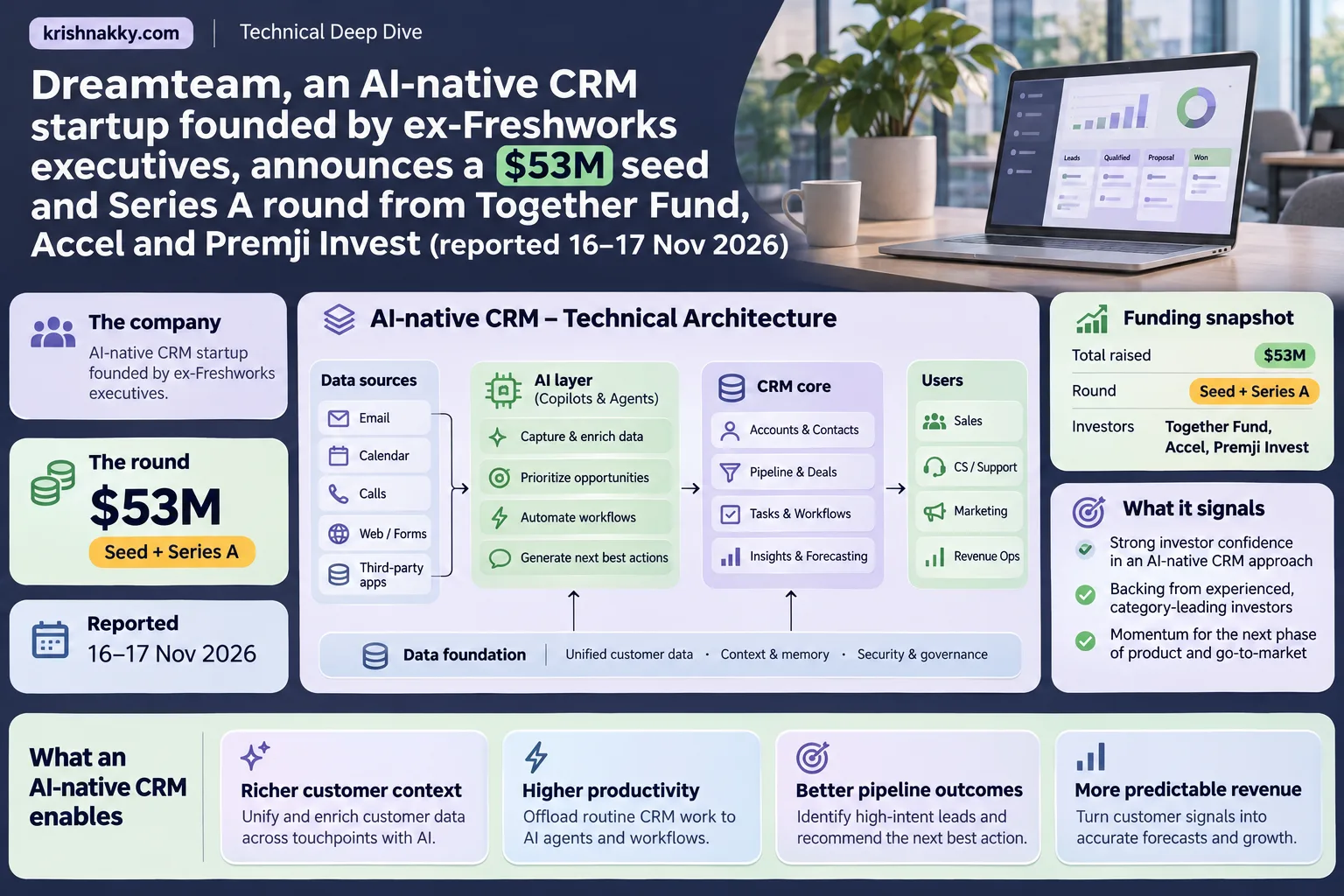
Dreamteam, a CRM startup started by former Freshworks executives, has raised $53M across a seed and Series A from Together Fund, Accel and Premji Invest. Reports conflict on which investor led which round, so I won't assign that. The pitch, as YourStory reports it, is a CRM built around AI agents that do the work, instead of a database that salespeople feed by hand. The company describes four named agents (Rachel, Sally, Raj and Alex) sharing a customer memory layer, and says it has 100+ customers in 13 countries. That customer figure is company-reported, and I haven't verified it.
In the headlines I read, including Inc42, the angle was the size of the cheque, the founders' Freshworks pedigree and pressure on Salesforce. I read only a few pieces, so I can't say what the wider coverage does or doesn't ask. The question I care about is who owns the record.
The problem is the data, not the UI
Everyone agrees reps despise logging calls and updating deal stages. So the obvious fix is an agent that listens to calls, reads email and fills the fields for you. That sounds plausible, and I haven't seen it run outside a demo.
But a CRM is not a notebook. It is a system of record. Forecasts, commissions, renewals and sometimes revenue recognition read from it. The moment an agent writes into those fields, you have a writer that is probabilistic, can be confidently wrong, and has no accountability. Anyone who has run live trading systems knows this pattern. We never let a model place an order and then shrug about the fill. Every write needs a source, a timestamp, a way to replay it and a way to reverse it.
The questions I'd ask before buying
- When the agent changes a deal from "negotiation" to "closed lost", which sentence in which email caused it, and can I see that without asking the vendor?
- If it is wrong on a Friday and the forecast rolls up wrong, can I undo one agent's writes without touching a human's?
- Does the agent act twice when a webhook is retried? Duplicate follow-up emails to a customer are a very visible bug.
- Who is the "author" in the audit trail when finance asks?
These are boring, ledger-style questions. They come from my own work on high-volume systems, where the exciting feature is a small part of the effort and idempotency, ordering and audit are the rest. I suspect Dreamteam's engineering budget will go the same way, whatever the demo shows.
I can't tell from public material how much of this Dreamteam already covers. Raj and Alex may handle some of the provenance and admin concerns above, and I haven't seen their documentation. Treat these as questions for a vendor call, not as claims about what the product lacks.
Why incumbents may be less exposed than the headline suggests
Salesforce and HubSpot don't win because of their forms. They win on integrations, permissions models, reporting that finance trusts, and years of customer data that is painful to migrate. That is my read, not something I have measured. An agent layer is easy to bolt on; a decade of trusted records is not. The incumbents will ship agents too. The real question is whether Dreamteam gets enough customers to trust it with the record before that happens, and 100+ customers (company-reported) is a start, not an answer.
A new entrant could design the data model for agents from day one: event-sourced history, explicit provenance on every field, confidence attached to every machine-written value. Whether Dreamteam actually did is something I haven't checked. Retrofitting that onto an old schema is hard, and that, not the "AI teammates" framing, is the bet I would look for if I were Accel.
One more thing worth noticing: this is an Indian-founded team, ex-Freshworks, going straight at a US-dominated category. Selling on architecture rather than price is a different game, and I am glad someone is playing it.
My take
I would pilot it, but only on a segment where a wrong write is cheap, like lead enrichment and meeting notes, and only after getting answers to the questions above. I would keep deal stage, amounts and forecast categories human-confirmed until the audit trail proves itself. If Dreamteam makes provenance and reversibility a first-class feature instead of an afterthought, it deserves the $53M. If it competes on how many fields the agent fills, it is a faster way to get a dirty database.