GPT-6.2 Astra Named a 1808 Sketchbook's Artist. The Part Backend Teams Should Copy Is the Checking.
A historian used a pre-release GPT-6.2 Astra to propose an artist for an 1808 sketchbook, then checked it himself. What backend teams can borrow: cheap verification and evidence logs.
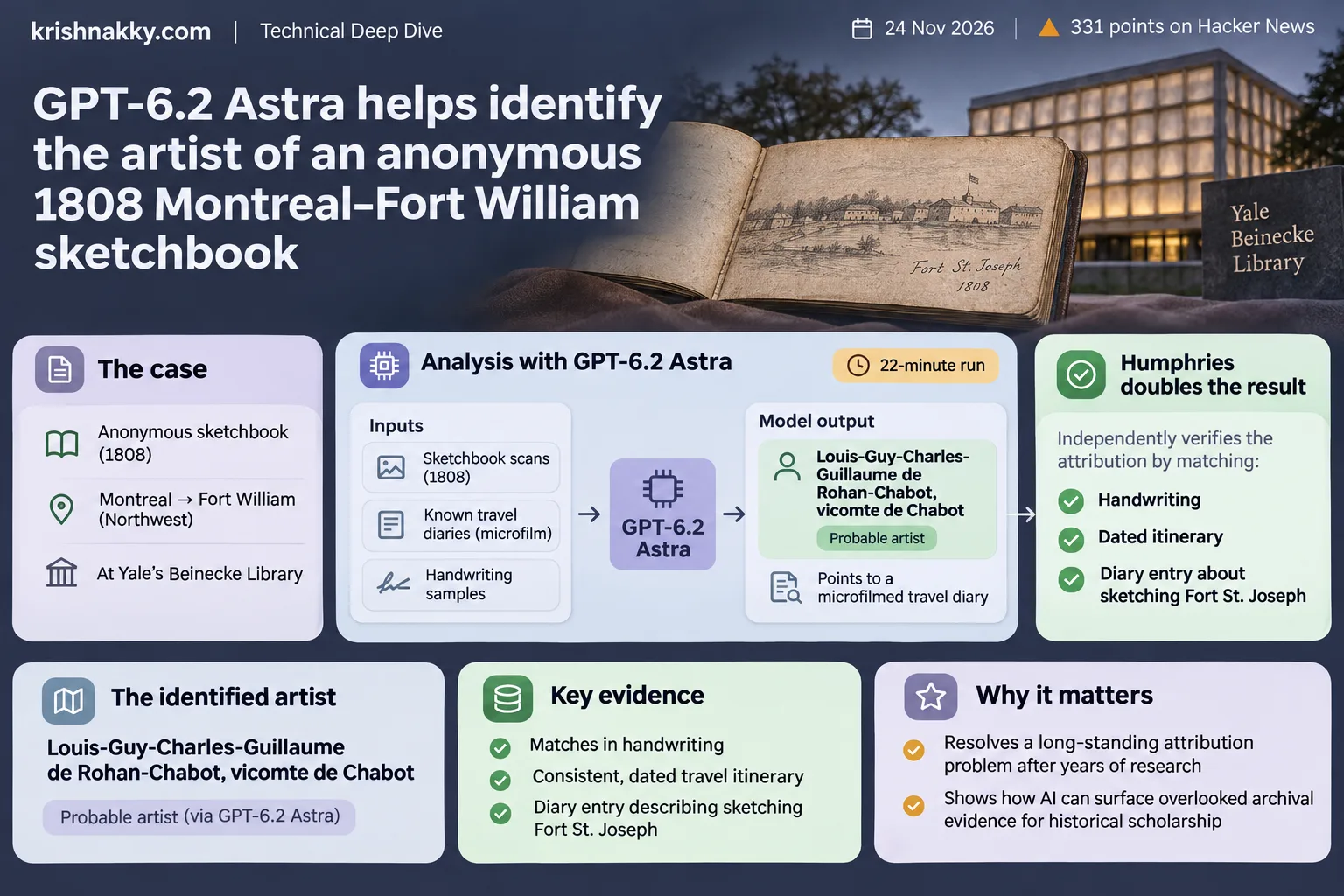
Historian Mark Humphries says a pre-release OpenAI model, GPT-6.2 Astra, named the "probable" artist of an anonymous 1808 Montreal-to-Fort William sketchbook held at Yale's Beinecke Library, in a 22-minute run, after he had failed for years. Reports name Louis de Rohan-Chabot as the proposed artist, but neither Yale nor other experts have confirmed the attribution, so treat it as a strong lead rather than a settled fact. He checked the answer himself against handwriting, the dated itinerary and a diary entry about sketching Fort St. Joseph. His write-up is here, and it's sitting at 331 points on Hacker News. The whole account, including the 22 minutes, is Humphries' own, and he gives no human baseline to compare it against.
Most coverage runs with "AI solves a mystery". What I'd take from the story is narrower: how the lead was checked matters more than which model produced it.
The model proposed. A cheap check decided.
Look at what Humphries actually did. Astra said "probably" and pointed at a microfilmed travel diary. Then a person with years of context ordered the documents by date and compared hands and itineraries. Accepting or rejecting the lead took an afternoon, not a research programme.
Generating a candidate is expensive for a human and cheap for a model. Confirming one is cheap if you've got a deterministic artifact to compare against. That's my reading, not something Humphries claims, and I have no data on how backend teams do this today. The risk I'd watch for is bolting a model onto fraud triage, reconciliation breaks or incident RCA and accepting a confident narrative with nothing to check it against. A narrative isn't a verifiable artifact.
If I were designing those flows (this is opinion, not a tested result), I'd refuse to ship any AI step whose output can't be reduced to something a machine or a tired on-call engineer can accept or reject quickly: a ledger entry that either exists or doesn't, a deploy timestamp that either precedes the error spike or doesn't, a transaction chain that either ties out or doesn't.
Provenance is where this story is thin
Humphries says the model's own account of how it found the diary was unclear, and the lead traced back to a footnote in a 2014 thesis. So the useful trail was reconstructed by a human afterwards.
I don't trust reasoning summaries as an audit trail, and nothing here changes that. They're a story the model tells about itself. In a regulated system, "the model explained itself well" won't survive an auditor's second question. What survives is the evidence: which documents were retrieved, which record IDs, which log lines, with hashes and timestamps. Log that. Treat the chain-of-thought as a debugging hint at best.
Pre-release and unreproducible
This was a pre-release model, and nobody can rerun the experiment. In history, that's an awkward footnote. In production, it's a change-management problem. If triage quality depends on a model you can't pin, you've got a dependency that can shift under you with no release notes. Pin versions where the vendor lets you, keep a replay set of past cases, and rerun it before any model swap.
Burke's pushback is right, and it generalises
Timothy Burke's objection, as I read it, is that this is attribution, not interpretation. A name on a sketchbook is a fact to be confirmed. What the sketchbook means is still a person's job. Same in our world: a model can flag a payment pattern as likely mule activity. Whether to freeze a customer's account is a judgment with consequences, and it stays with a human who owns it.
My view: build AI-assisted flows like Humphries worked. Let the model guess freely, make verification cheap and mechanical, log the evidence rather than the explanation, pin and replay the model, and never let the model make the final call on anything a customer or regulator will argue about later.