Intel Killed One Mono, Then Un-Killed It. Your Dev Tooling Has the Same Problem
Intel put its One Mono coder font on an open-source purge list in September 2026, then reversed course. A production engineer's take: every dependency, even a font or a CI tool, needs an owner, a pinned version and a vendored fallback.
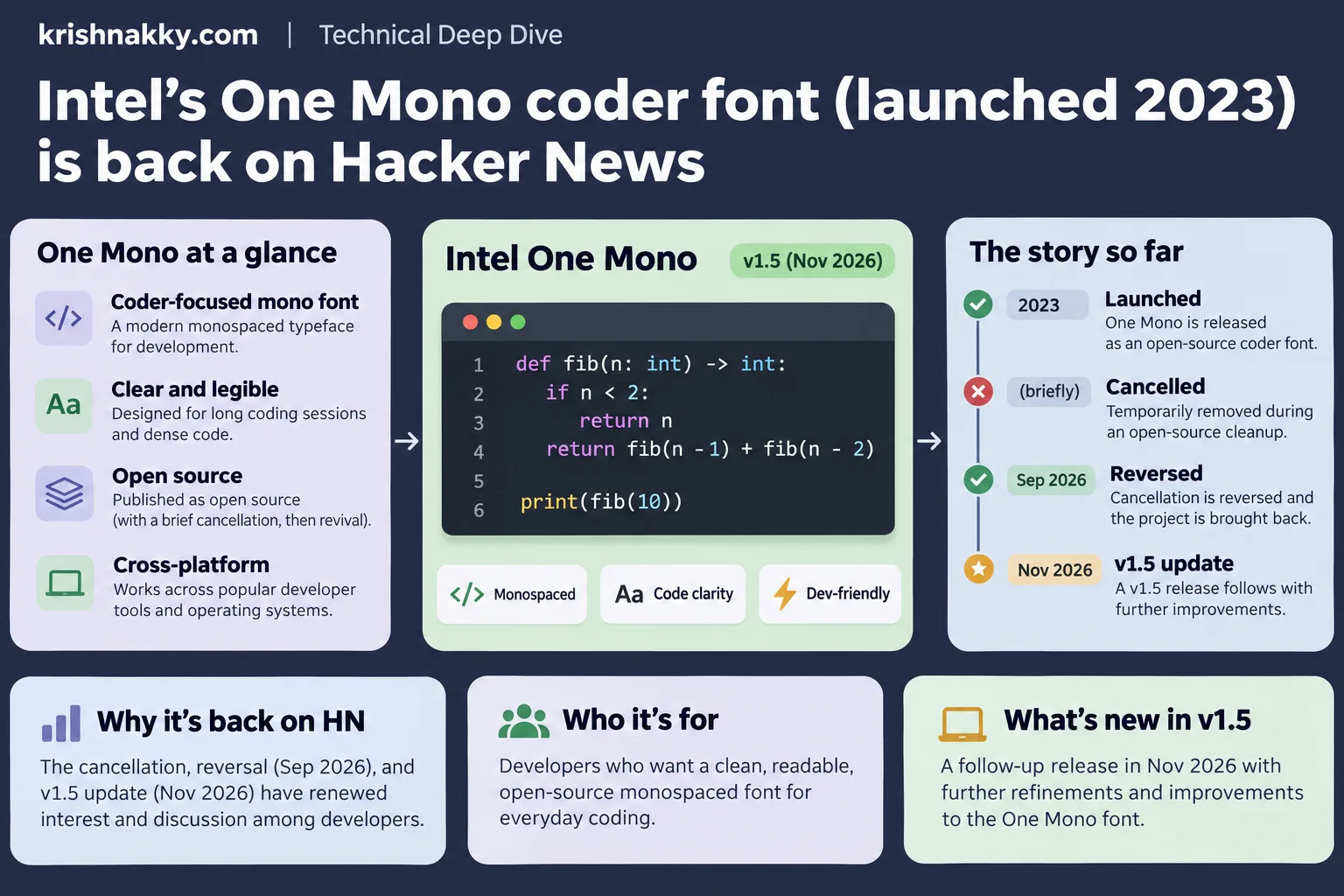
Intel's One Mono, a coder font built with low-vision readability in mind, is back on Hacker News. Intel briefly put it on an open-source cleanup list in September 2026 and then reversed the call, as Phoronix reported, and a v1.5 update followed in November.
This is a revival of September's news rather than a fresh event, and I couldn't establish why it resurfaced on Hacker News now; the v1.5 release is the only new development I can point to. I'm writing about it anyway because the near-miss is more useful than the font.
The repo was archived, then restored
According to the sources, Intel didn't just list the project: the repo was actually archived, so it was read-only for about two days before the reversal. I found no source saying whether users were consulted either way. The Tom's Hardware piece frames the reversal as a reprieve, which fits: nothing in the story promises the next cleanup will go the same way.
The lesson I take from it is narrower than a rule about sponsored projects. Stars, release cadence and a famous logo said nothing about this risk, and the repo went read-only anyway. I have no data on how often sponsored projects get archived compared with community ones, so I won't claim a pattern.
Where backend teams actually get burned
Most teams I've worked with are decent at watching runtime dependencies. The Spring Boot libraries, the JDBC drivers, the Kafka clients: those have owners, they sit in a dependency scan, and someone gets paged when a CVE lands.
Dev tooling gets none of that. Think of the formatter plugin nobody has touched in two years, the Gradle plugin maintained by one vendor's side team, the CI action pulled by a floating tag, the Docker base image from a repo that could be archived tomorrow. A stale build plugin can sit there for a year because it never touches production traffic, and then one broken build stops the release train.
The tooling is just as much part of your delivery path. If your pipeline can't build when a sponsor walks away, you have an outage that happens to occur before deployment. I made a related argument about change management in the November outage cluster: the unglamorous layers fail the same way the glamorous ones do.
What I'd actually want in place
Three things, all of them plain housekeeping.
An owner. One named person per tool, including the font in the shared editor config and the lint rule set. If nobody can be named, that's your answer about how much you depend on it.
A pinned version. Not a range, not "latest", not a floating tag. Pinning doesn't prevent abandonment, but it stops you finding out during a deploy.
A vendored fallback. A copy of the artifact in storage you control: the source tarball, the container image, the binary. When the upstream repo is archived or the registry entry vanishes, you rebuild from your copy while you decide whether to adopt, fork or replace. For the font itself this is legally straightforward: One Mono is released under the SIL Open Font License, which permits redistribution, though you should check the license text for the conditions that apply to copies and modified versions. Check the license of any other tool before vendoring it.
None of this is expensive. It's an afternoon per tool and a quarterly glance at the list. The cost shows up only when you skip it.
The font itself
One Mono was designed with low-vision readability in mind, and the project page on GitHub says so plainly. I'm not a typography expert and I won't judge the letterforms, and I don't have evidence on how much a font changes reading speed or error rates in logs. What I can say is that engineers who rely on a readability-focused font have a concrete reason to keep it available, which is a good reason to give it the same treatment as any other dependency: an owner, a pin, a copy.
My position
Intel did the right thing by reversing, but I wouldn't build on the reversal. Treat any sponsor's goodwill as a variable, not a constant. Fork the font files into your own repo today, pin the version, and put the same discipline on your CI and build tools that you already apply to runtime libraries. If a dependency matters enough to use daily, it matters enough to hold a copy of.