Java4Shell: Your Dependency Scan Is Clean and Your JVM Is Still the Hole
Java4Shell (CVE-2026-114938) is a pre-auth RCE in OpenJDK's HotSpot compiler code (the AVX-512 VBMI Base64 intrinsic), not in any framework. A production engineer's take on why the JDK is now a tier-0 asset and why dependency scans miss it.
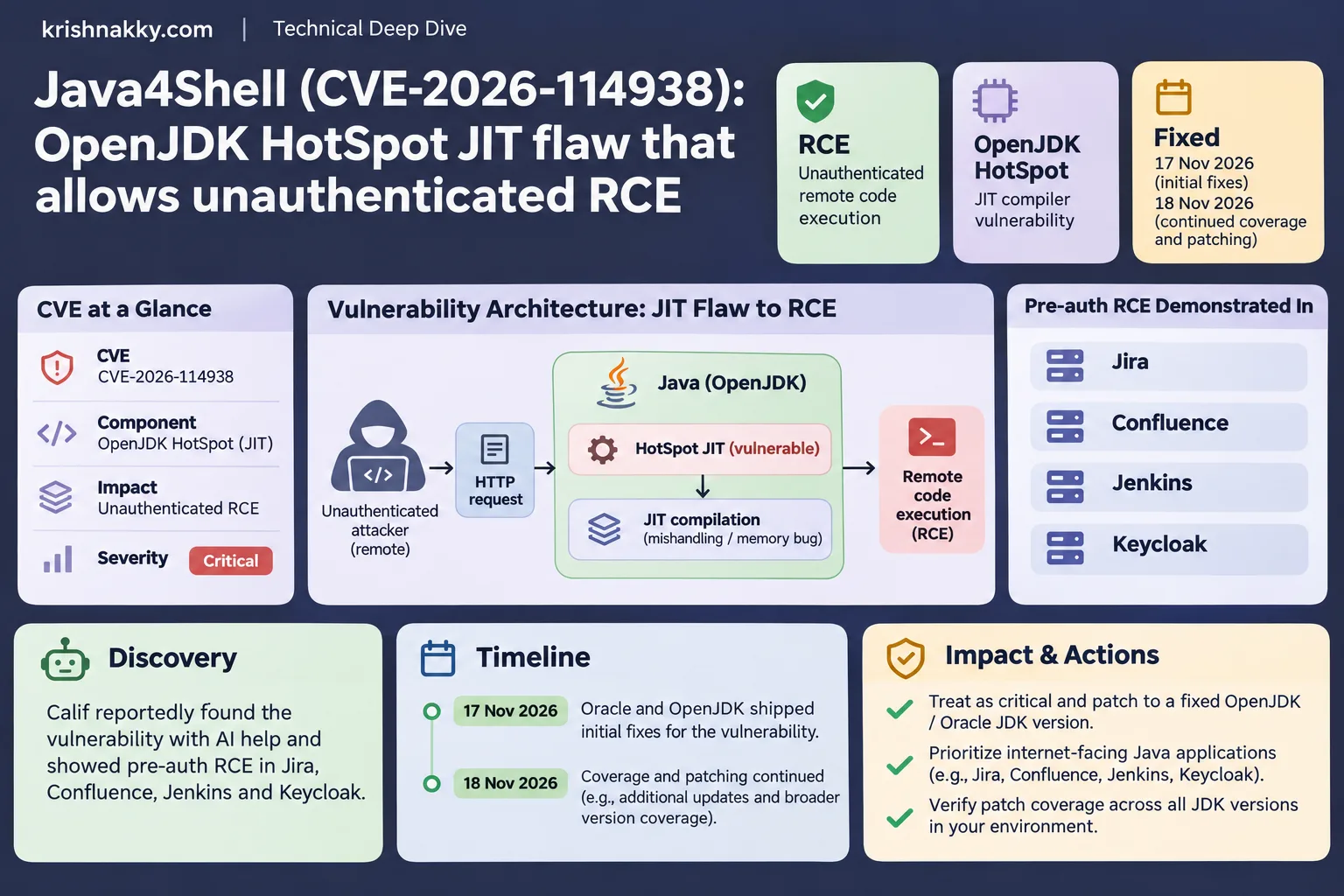
Java4Shell (CVE-2026-114938) is a flaw in OpenJDK's HotSpot that allows unauthenticated remote code execution. To be precise, it sits in the AVX-512 VBMI Base64 decoder intrinsic, which OpenJDK files under hotspot/compiler. It is not a bug in the JIT compiler as a whole. Oracle and OpenJDK shipped fixes on 17 Nov, and researchers at Calif reportedly found it with AI help and demonstrated pre-auth RCE against Jira, Confluence, Jenkins and Keycloak. The Hacker News has the full write-up.
The bug is not in Spring, not in Jackson, not in some transitive jar. It's in the runtime underneath all of them.
Your clean dependency tree is irrelevant here
I've spent nine years in Spring Boot shops where "security" mostly meant a dependency scanner in CI and a Friday ritual of bumping versions. That habit doesn't cover this. Classic SCA tools read your pom or lockfile, and many teams never point them at the JDK in the base image, which is where Java4Shell lives. Some SCA and container scanners do flag JDK versions, but only if you've enabled that. A service with a spotless dependency report is as exposed as a messy one if both run an affected build.
Whether you have an affected build is a narrower question than "do we run Java." Reports say the flaw only reaches hosts whose CPUs support AVX-512 VBMI, and that Java 8 and 11 are not affected. Check your JDK version and the instance types you actually run on, not just the version string.
The write-ups I've read, including SecurityWeek's coverage and the watchTowr FAQ, mostly say "patch now." That's correct but doesn't tell you how. The harder part is what patching means for a JVM.
A running process keeps the old code
Patching a JDK is not like patching a library you can swap in a deploy. The bytes on disk change, but every JVM already running keeps executing the vulnerable code until it restarts. So the real job is: rebuild base images, redeploy everything, and prove nothing is still running the old runtime. In my airline work, 130M requests a day meant you could not bounce a fleet casually. You rolled in waves, watched error rates, and kept a way back. That discipline now has to apply to the JDK itself, not just app releases.
And in trading or payments, a JVM restart is not free. Warm-up, connection state, in-flight orders. Nobody wants to learn their restart procedure during an active exploit window.
What I'd actually do about it
Treat the JDK like a tier-0 asset, the same class as your OS and your TLS terminators. Concretely:
- Know what you run. Most teams cannot answer "which JDK build is in production, per service" in under an hour. That inventory should exist before the next one, not after.
- Canary the runtime. Runtime upgrades deserve the same staged rollout as code changes, because a JDK update can change performance and behavior in ways unit tests won't show.
- Have workarounds rehearsed. Sources report
-XX:-UseBASE64Intrinsicsas a mitigation. It's only useful if someone has already measured what it costs your Base64-heavy paths. Nobody should be experimenting with that at 2 AM. - Don't assume your vendor has caught up. Vendor status was mixed across the reports I read, and Red Hat in particular is reported to have shipped fixes on 19 Nov (RHSA-2026:100563 and following). Your "just pull the latest image" step depends on your distribution's schedule, so verify against its advisory. See also the startupfortune summary for the AI-discovery angle.
The AI discovery angle
That this was reportedly found with AI help matters beyond this one CVE. If models make it cheaper to dig bugs out of mature, heavily reviewed code like HotSpot, runtime-level disclosures may arrive faster and more often. Oracle shipped an out-of-cycle build on 17 Nov, so the vendor can move faster than the quarterly schedule. The question is whether your pipeline can absorb an out-of-cycle JDK in days rather than waiting for the next window.
Panic patching without canaries is also how you turn a security event into an availability event, which is why the canary and rollback steps above matter as much as the patch.
My take
The JDK needs an owner. In fintech, airline and market infrastructure, it should have an owner, an inventory, a canary path and a tested rollback, exactly like any service you ship. Teams that build that this week will shrug at the next Java4Shell. Teams that don't will keep waiting for a scanner to tell them something the scanner cannot see.