Linux in a Browser Tab: The Wisp Relay Is the Real Story
Farid Zakaria's trynix.dev runs Firefox and git clone inside a browser tab. The part a backend engineer should care about is the WebSocket relay carrying every TCP connection.
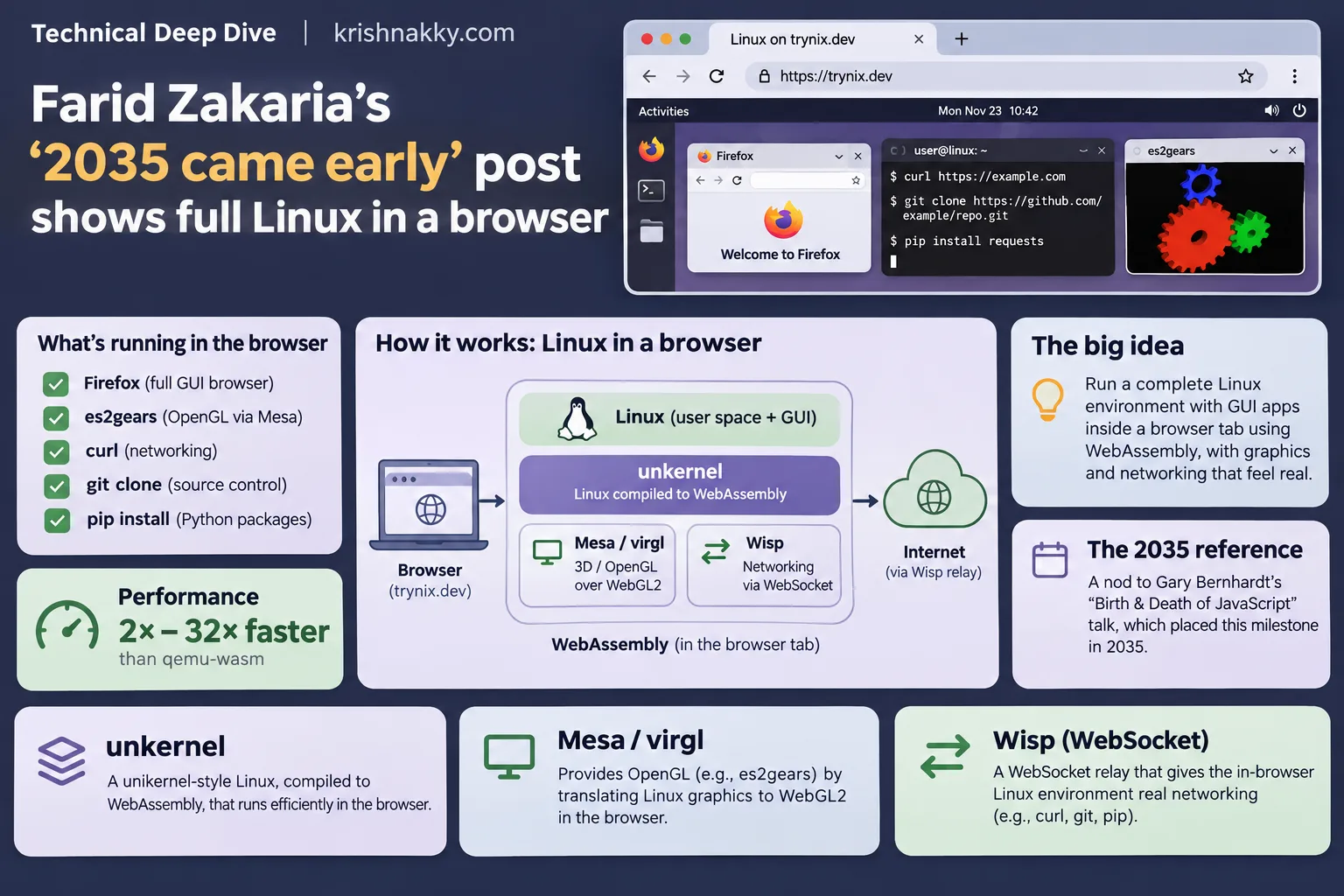
Farid Zakaria's “2035 came early” shows Firefox, a GL demo, git clone and pip install running as a real Linux userland inside a browser tab on trynix.dev. The engine is "unkernel", Linux compiled to WebAssembly, and the post claims it beats qemu-wasm by 2x to 32x. The title is a wink at Gary Bernhardt's "Birth & Death of JavaScript" talk. The screenshots show the guest. They don't show how its network traffic leaves the tab.
The tab is not the system
As I read Zakaria's post, the demo's network calls go through a Wisp relay. That is his description, and I found no independent coverage of Wisp to confirm it. A browser tab can't open a raw TCP socket, so the guest's connections would have to be wrapped and carried over a WebSocket to a server that opens the real connection. If that's right, git clone works because a machine you don't see is dialling GitHub on your behalf.
The post doesn't say how trynix's relay is run, so what follows is my inference about any relay of this kind, not something the project claims. I see three jobs:
- Trust boundary. The relay sees every destination the guest connects to. With TLS terminated in the guest it would likely still see SNI hostnames and traffic patterns, though exactly what depends on the relay's implementation.
- Egress allow-list. An open relay is an anonymous TCP proxy for the whole internet, so a public one needs some policy about who can reach what. I don't know what trynix does here.
- Cost centre. Bandwidth, connection counts and idle sockets land on whoever hosts it. Zero install does not mean zero cost, because the cost moves server-side.
Where this could be useful
A sandbox that boots instantly and is reproducible from Nix packages looks like a fit for running untrusted code from AI agents. CI previews and developer onboarding are other candidates. The project doesn't claim any of these, so treat them as my speculation.
For agents, the sandbox is the easy half. The hard half is the question compliance teams ask next: what did it talk to? If an agent's traffic all passes through one relay, that relay could double as an audit log and a kill switch. That is hypothetical, and it would only hold if the relay were built to log and enforce.
It also means whoever runs the relay holds the real power. A hosted one is a vendor who can see your agent's traffic. A self-run one is one more production service you have to keep honest. Either way, "sandboxed" describes the guest, not the system.
The caveats
This is a single-author demo and the speed numbers are Zakaria's own. I found no independent coverage of unkernel when I looked. The tombl/linux port and its mailing-list announcement are the groundwork it sits on, and qemu-wasm has its own paper. I'd treat the 2x-32x as a claim until someone else reproduces it on a workload that isn't a demo. The Hacker News score of 889 comes from my signal feed and I haven't checked it myself.
My view: if you plan to run agent code or CI previews this way, the server still exists, so design the relay first. Deny by default, log every destination, and put a per-session budget on it before you write any guest-side tooling.