OpenAI's n^2.25 Matrix Multiplication Claim Won't Speed Up Your Stack
OpenAI says the matrix multiplication exponent is nine-fourths. A production engineer's read: why a galactic algorithm changes nothing for GEMM, and why an unreviewed AI-made proof needs staged trust.
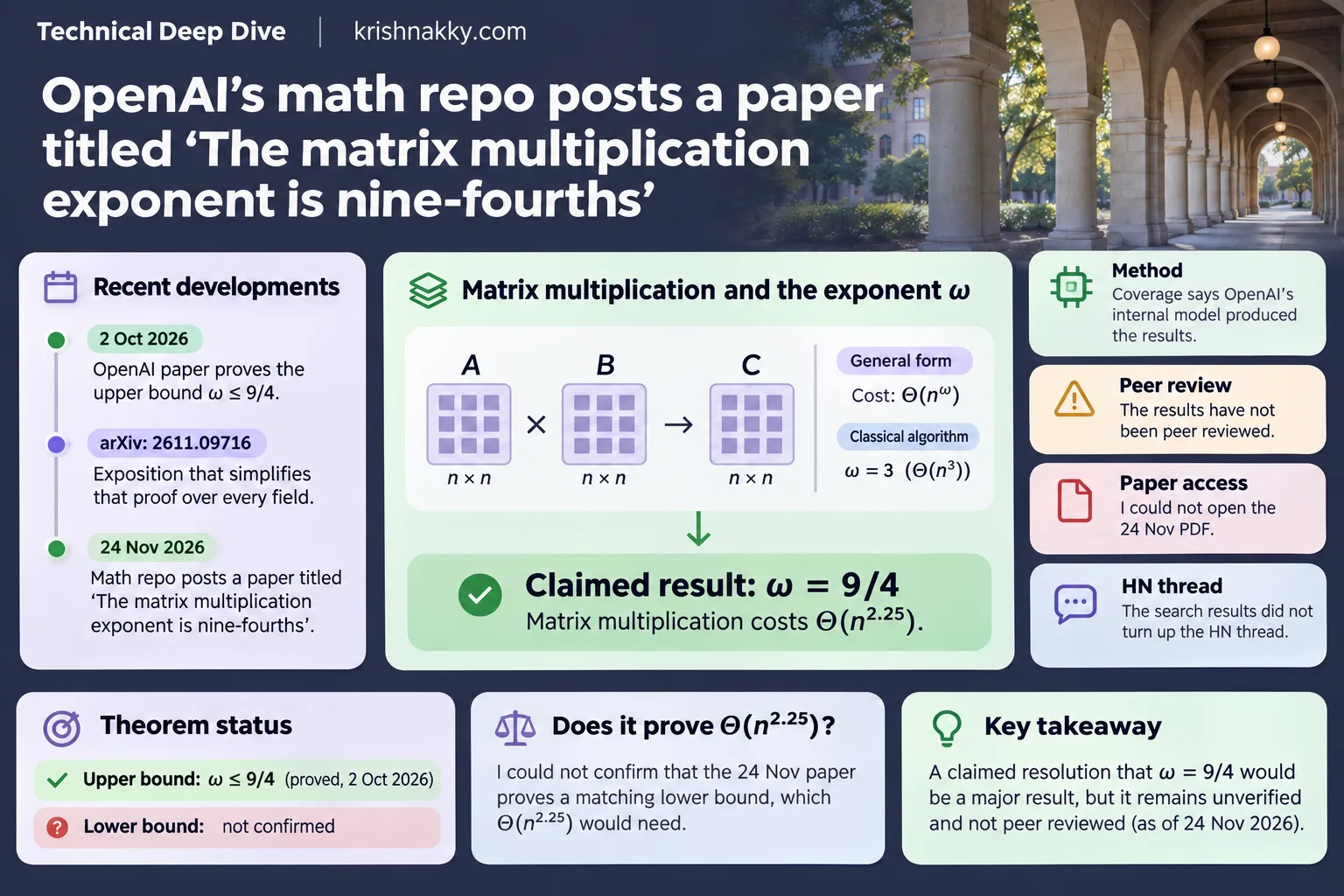
OpenAI's math repo has posted a paper titled "The matrix multiplication exponent is nine-fourths", dated 24 Nov 2026, building on an October result that put the exponent at no more than 9/4, so roughly n^2.25 operations to multiply two n×n matrices. Coverage says an internal OpenAI model produced the work, and none of it has been peer reviewed (OfficeChai's write-up).
The paper and its README are public on OpenAI's GitHub, and the 24 Nov paper claims a matching lower bound of ⌈n^/2⌉ gates. That bound is scoped to division-free arithmetic circuits, so it is not a lower bound for every possible algorithm, and nobody outside OpenAI has verified it. The upper bound is the part laid out in the arXiv exposition, and Rafael Pass has published an independent proof, which is the strongest verification so far. Read "Θ(n^2.25)" as "tight within division-free circuits, per the authors" until review catches up.
The headline everyone will write
"AI just made all AI faster." No. I'd bet money against that reading.
This is a galactic algorithm. The exponent drops, but the hidden constants and the machinery needed to reach it are so heavy that OpenAI's own paper reportedly says the proof gives no competitive matrix size, meaning no n where it beats a plain well-tuned multiply. We've been here before. Strassen-family tricks and the long chain of improvements Quanta covered in 2024 never made it into the kernels that run your models. Shaving the exponent is a result about what is possible, and a new exponent doesn't come with a faster multiply you can run.
Where real speed comes from
Systems usually get fast or slow for boring reasons. A matrix multiply on real hardware is dominated by how well you keep data close to the arithmetic units. Cache locality, tiling, memory bandwidth, batching, and vendor kernels in BLAS and cuBLAS that someone has tuned to the specific chip. None of that appears in an exponent. An algorithm with a beautiful big-O and a cache-hostile access pattern loses to the "worse" one every time, usually by a wide margin.
Numerical stability is the other quiet killer. Strassen-family methods are known to give up some numerical stability, and in float32 or bf16 that is not a footnote. I haven't seen the error analysis for this new algorithm, so I won't claim it shares that weakness, but I'd want it before trusting it. If your pricing or risk engine needs results that reproduce to the last bit across runs, an exotic scheme is a liability until proven otherwise.
What it means if you run risk or pricing math
If you maintain a covariance pipeline, a Monte Carlo risk batch, or a factor model on a trading or fintech stack, nothing changes on Monday. Your slow job is slow because of data layout, a copy you didn't know about, a thread pool fighting over memory bandwidth, or a Python loop where a batched call should be. Profile first. Fixing layout, copies and contention is where the practical wins are, and no theorem will offer you those.
The part I find more interesting
The claim arrived from a model that outsiders can't run, and the paper hasn't been through review. Maybe it's right. The follow-up exposition by independent authors is a good sign, and it's exactly how this should work. But it's the same verification problem as an unreviewed change heading for production. Who checks it, with what, and how much do we trust it meanwhile?
The answer in engineering is the same too: independent verification by people who didn't produce the work, checks anyone can reproduce, and trust that grows in stages. A proof that a second team can re-derive, or that a proof assistant can check mechanically, earns more trust than "the lab says so". I made a similar argument about emergency patches in the November outage cluster. Speed of production is not evidence of correctness, whether the producer is a model or an on-call engineer at 3 a.m.
My position
Congratulate the mathematicians, wait for the reviewers, and keep your matrix code exactly where it is. If someone pitches you a speedup because of this paper, ask for a benchmark on your own hardware at your own matrix sizes. Until one exists, the exponent is trivia and your profiler is the thing that matters.