Microsoft's 365 Outage Was a Failover Story, Not a Bug Story
A months-old gateway defect lay dormant until a Teams failover shifted traffic onto it. What it means for failover load, rollback and retries.
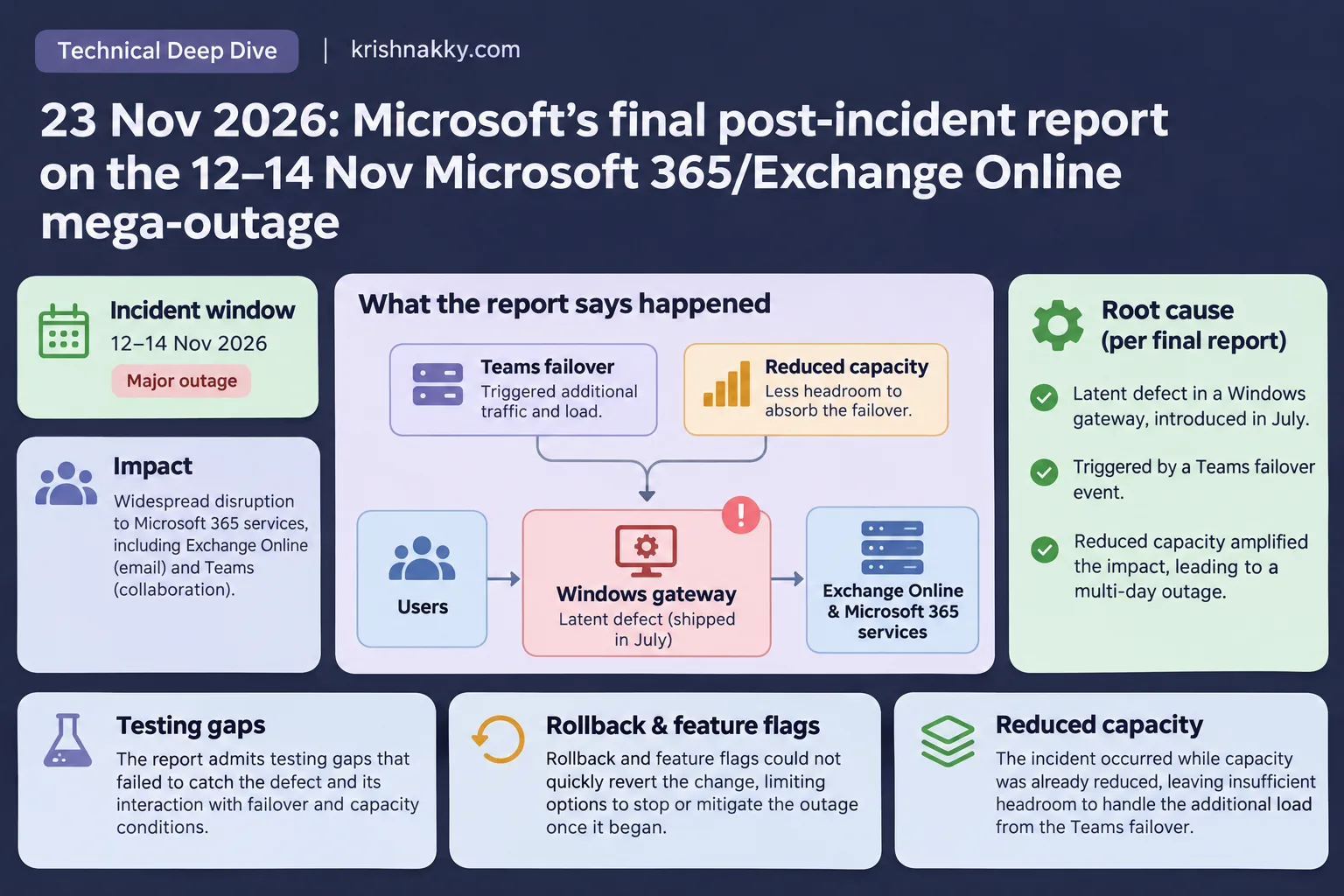
Microsoft says the 12–14 Nov Microsoft 365 and Exchange Online outage came from a Windows gateway defect shipped in July, set off when a Teams failover and reduced capacity pushed traffic onto it. The Register's 23 Nov coverage adds the uncomfortable parts: admitted testing gaps, and a rollback and feature-flag setup that could not quickly undo the change. ChannelDive and iTnews also cover the final report and the testing-gap admission, and Microsoft's own post-incident report is published in the admin center under EX1550543 and MO1550821. The earlier preliminary account from mid-November set out the root cause.
Most coverage leads with "months-old bug, scary," but the bug explains little. Every large codebase has dormant defects. What turned this one into a multi-day event was the recovery path.
Failover is where your redundancy shares fate
A failover moves load. Whatever you're failing over to now carries its own traffic plus someone else's. If that target has a defect that only shows up under higher load, the failover doesn't save you. It delivers the trigger.
A standby looks healthy for months because it handles almost nothing. The day the primary drops, it takes the whole load for the first time, and any defect that depends on load shows up then.
So my first rule for Java and Spring Boot teams: load-test the failover target at failover load, with the failover traffic mix, on production-class hardware. If your capacity plan says "N+1" but your tests only ever run at N, the standby is untested at the load it exists for.
Feature flags only cover what you flagged
The detail that stuck with me is that normal rollback and flighting couldn't revert quickly. A flag protects the change you wrapped in it. A July change that went out as part of ordinary code has no switch. By November it is tangled with everything built on top of it, and reverting it means reverting other things too.
Old changes are the hardest to undo, and they are also the ones nobody is watching. The audit I'd run: for each component on your critical path, name the last change to it that you could not revert within an hour. That list is your real risk register. In a Spring Boot service, the difference looks like this:
@Bean
@ConditionalOnProperty(name = "payments.new-router.enabled", havingValue = "true")
PaymentRouter newRouter() { return new NewPaymentRouter(); }
Flip that property and the new router is gone. A rewrite merged straight into the main path has no such switch. I made a similar argument about control planes in the AWS Identity Center outage piece.
Hold-and-retry beats bounce
The part of the Register headline about emails that never arrived is the lesson for payments people. A delivery path that queues and retries within a defined window is far better than one that rejects fast and tells the sender to figure it out. Microsoft extended its retry window from 24 to 48 hours for this reason. For payment instructions and customer notifications, a delayed message is recoverable. A bounced one forces every upstream system to invent its own recovery logic.
Retries carry their own risk, though. Microsoft's later root-cause update cites a change that caused an influx of retry requests routed through the servers. Unbounded or synchronized retries turn recovery into a second outage. If you build messaging or payment rails, make hold-and-retry the default, use exponential backoff with jitter, cap attempts, bound it with an explicit expiry, and make sure the queue itself isn't sitting on the same gateway that's failing.
Judge the report by what it admits
I read post-incident reports for one thing: do they name the testing gap in plain words? A report that says "we will improve our processes" tells me nothing. One that says the load tests ran on the wrong hardware profile tells me exactly what to check in my own pipeline. By that standard, the testing-gap admission matters more than the root cause.
My view: stop treating failover as a feature you configure once. Give it its own load test, its own rollback plan, and its own owner. If nobody can say how the standby behaves at full traffic, assume it doesn't.