Apple, NSANet and the 12–17 Nov Outages: Routine Changes Keep Breaking Things
Apple iCloud sign-in and NSANet both failed on 17 Nov 2026 after routine internal changes. What it means for payments and trading systems.
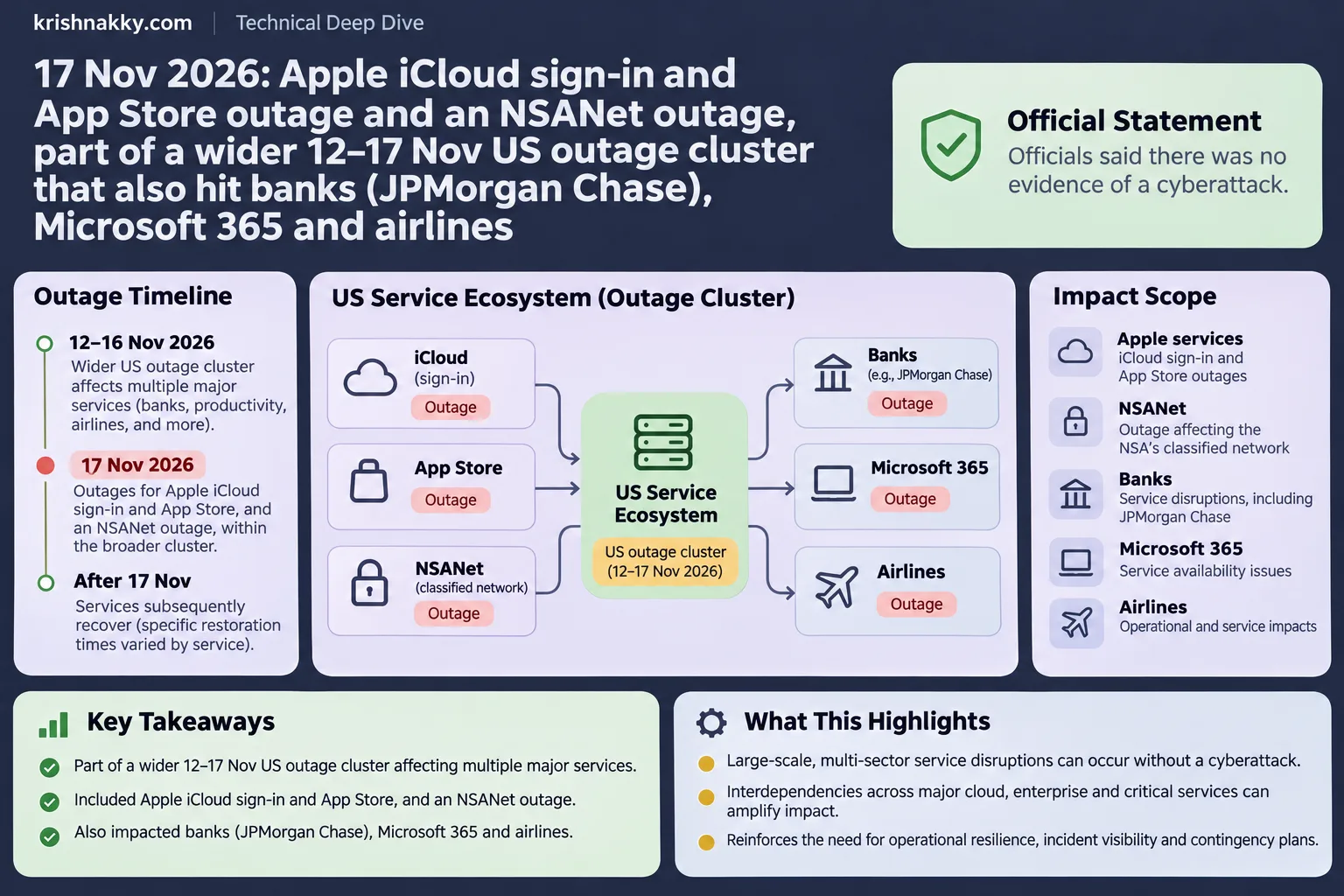
On 17 Nov 2026 Apple's iCloud sign-in and App Store went down for hours, and the NSA's classified network, NSANet, had its own outage the same day. Both were part of a messy 12–17 Nov run of US failures that also touched JPMorgan Chase, Microsoft 365 and airlines, and officials said they saw no evidence of a cyberattack (BNN Bloomberg).
First, a caveat. Nobody has shown these incidents share a cause. The Cloud Security Alliance's research note is explicit that the evidence for a single root is thin, and it is the only source I found that groups them. Its count of nine failures rests on that one note, so treat it as a framing, not a finding. A week like this can be coincidence plus a news cycle that went looking for a pattern.
A shared cause and a shared shape are different things, though, and the shape is what I care about.
What Apple and NSANet have in common
Apple said an "internal update" broke things. NSANet's operators said "scheduled routine maintenance." Neither points to an attacker. Both read like someone pushed a normal change to a normal system, and a dependency nobody had fully mapped failed. In the Apple case, what failed was sign-in.
That detail matters. Identity sits in front of almost every modern stack, so when it stops answering, everything downstream that asks it a question first stops too. I wrote about the same pattern after the AWS us-east-1 Identity Center outage two days earlier. Different company, same pressure point.
Why I weigh change risk heavily
None of these were attacks, so "attack surface" is a loose label. What I mean is narrower: in my own on-call experience, most of the incidents I've handled were triggered by a deploy, a config push or a migration, not a failed server. That's one engineer's anecdote, not evidence. Hardware faults, capacity limits and vendor failures still cause real outages, and they're not gone. But those are the failure modes we've spent decades hardening against, and change is the one we keep reintroducing ourselves.
What this means if you build payments or trading systems
I work on Spring Boot services that move money and talk to markets, so here are concrete things I'd do:
- Roll out in stages, for real. A canary that gets 1% of traffic for ten minutes isn't a canary if the failure only shows when a token expires an hour later. Hold the canary for longer than your longest token or session TTL, and include the awkward users.
- Have a kill switch that doesn't depend on the thing you're killing. If your rollback path needs the same auth service you just broke, you don't have a rollback. Keep feature flags in local config or a store with no dependency on your identity provider.
- Degrade when auth is down. In a Spring Security resource server, cache the JWKS and validated entitlements with a short TTL, say 5 minutes. Wrap the identity provider call in a Resilience4j circuit breaker that opens after a 50% failure rate over 20 calls. While it's open, allow read-only and risk-reducing actions like cancelling orders and closing positions, and reject anything that opens new exposure. Write that rule down before the outage, not in a war room.
- Map your vendors' vendors. Your bank connectivity might be three clean boxes on your diagram and one shared identity provider underneath all of them. Ask who your provider's provider is. Most teams can't answer it.
My position
Don't treat your auth provider as a utility that's always on. Design for it being unavailable, test that path monthly, and treat every maintenance window, yours or your vendor's, as a likely source of your next incident. Then check that your system can survive its own routine change before you add more security tooling.