The November Outage Cluster Wasn't an Attack. It Was Change Control Under Pressure
Microsoft 365, an FAA ground stop, Chase and Apple failed within days. The causes were ordinary change and capacity failures, and they show why emergency patches need full rollback discipline.
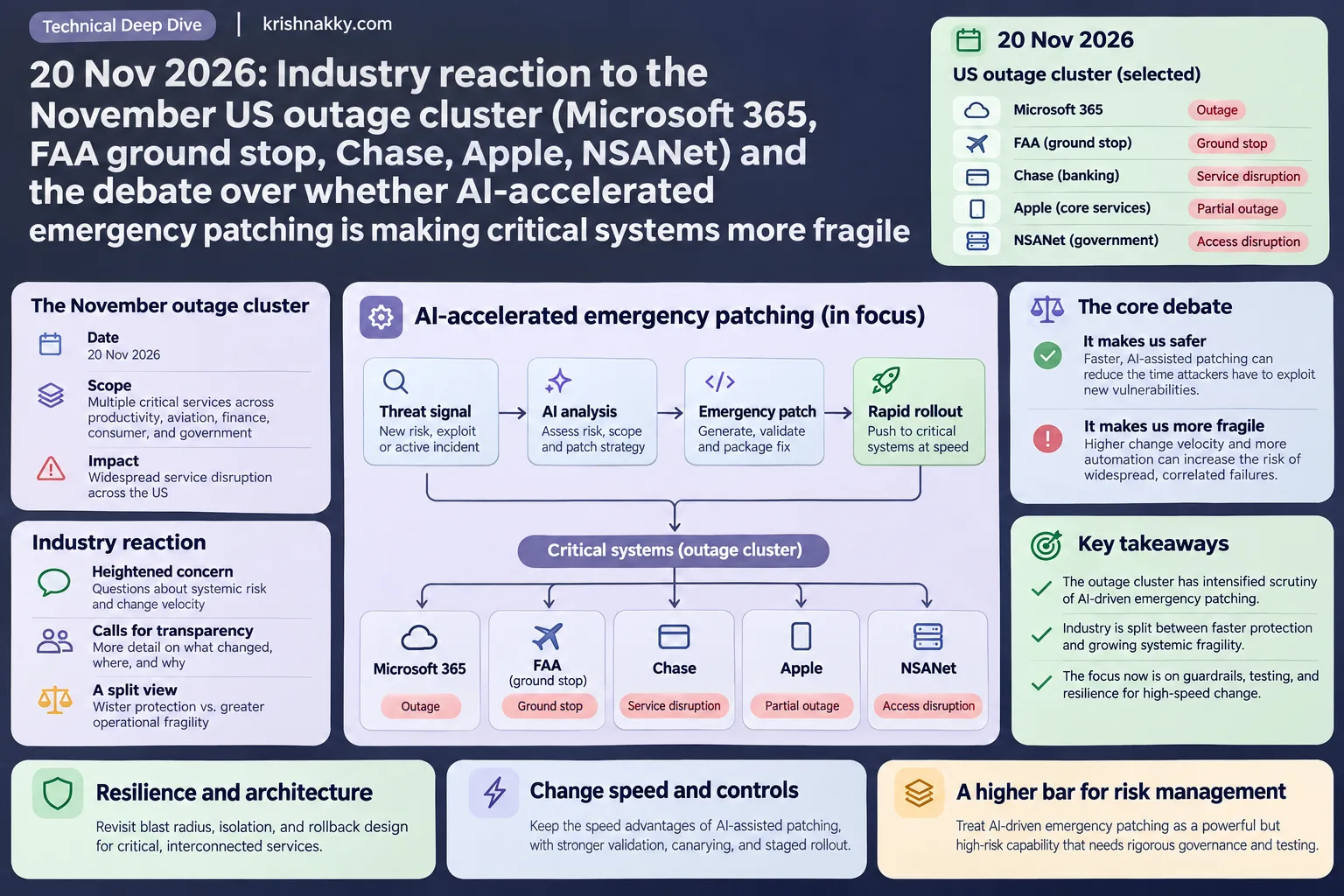
In the space of about a week, Microsoft 365 mail, an FAA nationwide ground stop, Chase's online banking and Apple's services all went down. SecurityWeek's reaction roundup captures the argument now running: is AI-accelerated emergency patching making critical systems more brittle? A separate digest also claims a classified NSA network went down. I couldn't confirm that one, so I leave it out of the count below.
I've read the coverage, and most of it is stuck on one question: attack or not? Officials say no evidence of an attack. I believe that, and I think the question is the wrong one.
What the sources say broke
The public causes are mundane, and none is an emergency security patch:
- Microsoft 365: a gateway update from July 2026.
- FAA ground stop: an aging or overloaded router during a fiber upgrade.
- Apple: an internal update.
- Chase: a software bug.
Root-cause statements are thin and partly conflicting, so treat this list as the best available picture, not a final verdict. Every item is a change-and-capacity failure. The evidence shows ordinary change control failing in four places at once. It does not show AI-driven patching causing these outages.
Correlated fragility, as a hypothesis
The Cloud Security Alliance research note uses the phrase correlated fragility. It is a single research note, so I read it as a hypothesis worth testing, not a finding. The idea: you don't need one adversary. You need many organisations under similar pressure, shipping changes into systems that were never built to absorb them.
Is AI part of that pressure? Plausibly. AI-assisted tooling surfaces exploitable flaws faster than a normal patch cycle can digest them, and CISA added four more entries to its known-exploited list the same week. I have no evidence those four entries touch any of the affected organisations, so I'm citing it as background on the patch tempo, not as a cause.
Why emergency patches deserve the same scrutiny
The bottleneck has moved from finding the hole to changing a tightly coupled system without breaking it. Release processes built for quarterly cycles don't stretch to cover that.
In live trading infrastructure, nobody ships to a matching path or an order router on a Friday because a scanner flagged something. You canary it, you roll it to a small slice, you watch the p99 and the reject rates, and you have a rollback that has been exercised, not merely documented. A kill switch sits within reach of whoever is on call.
In my own experience, a CVE with a headline often gets a "hotfix" label, and the label can quietly exempt it from the checks everything else faces: smaller review, fewer environments, and a rollback plan that assumes the old version works with whatever state the new one has already written. That's my observation from a few teams, not an industry survey. It is, though, a common way for a patch to become an outage.
What I'd tell teams building these systems
An emergency patch is a production change. It needs the same stages as any other change, run faster through pre-built pipelines, pre-approved canary steps and rollback rehearsed before the crisis.
Practically, that means three things for bank, airline and exchange stacks:
- Limit the blast radius so no single patch can touch every region or every customer segment at once.
- Make rollback a tested path, including data and schema state, since a rollback that corrupts state is just a second outage.
- Keep a kill switch to disable the new behaviour without redeploying.
I made a similar argument after the Apple and NSANet failures in Change Management Is the New Attack Surface.
My position: this cluster doesn't prove that rushed patching is the new top outage cause, but it does show how much damage a poorly staged change can do. If AI keeps compressing patch timelines, the teams that rehearse rollback and limit blast radius will be the ones still standing. I'd expect more outages of this kind, and I'd want evidence on each before blaming patch velocity.