Razorpay's Reported UDRHP: What I'd Read First on Payments Margins
Razorpay is reportedly about to file its updated DRHP with SEBI. A payments engineer's list of what to check: take rate, reconciliation cost, and what sits above zero-MDR UPI.
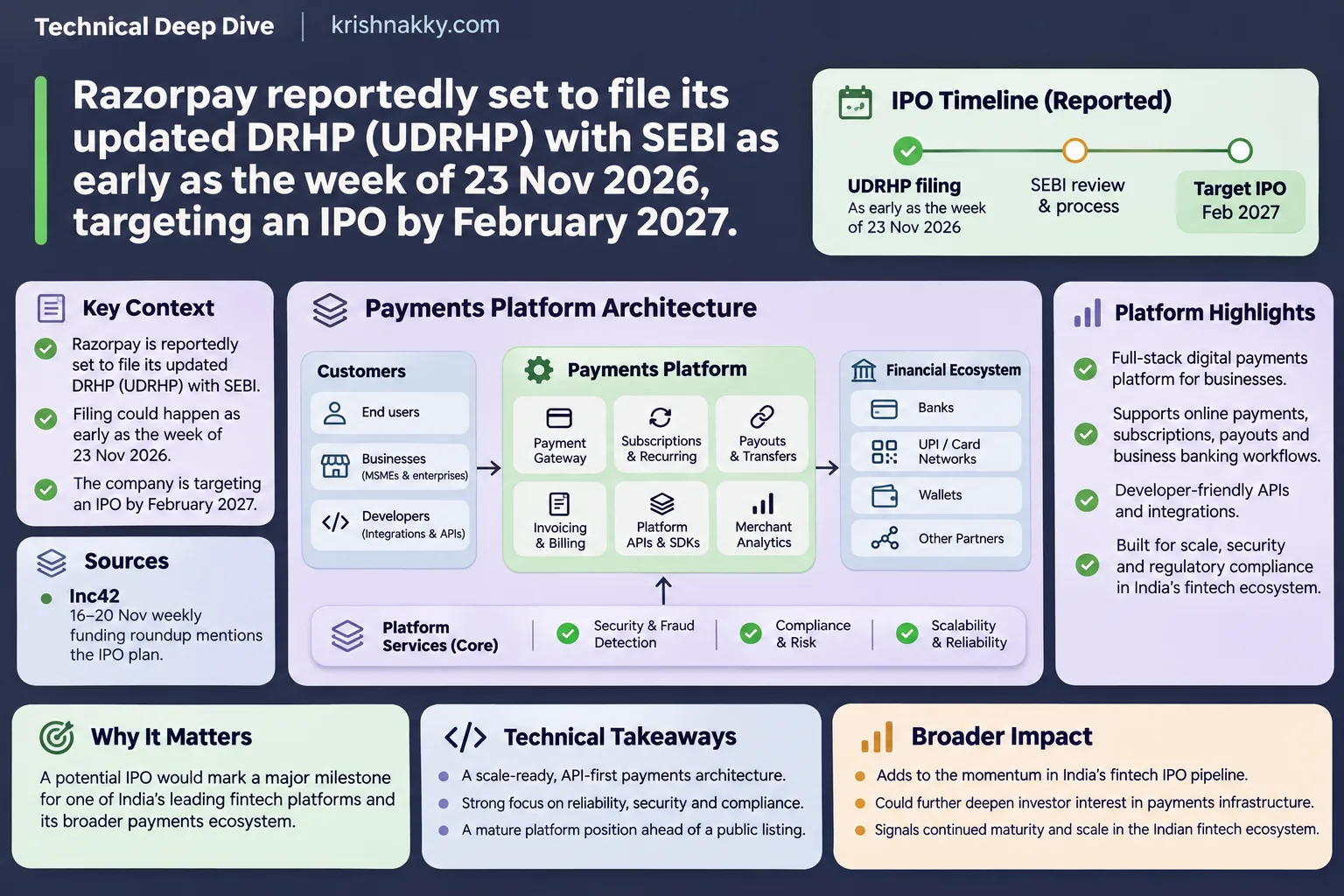
Razorpay is reportedly preparing to file its updated DRHP (UDRHP) with SEBI within days of the 23 November report, aiming to list by February 2027. It had earlier filed confidentially, and SEBI is reported to have cleared the draft on 3 November, which is what lets the public UDRHP follow. Inc42's weekly funding roundup repeats the plan. Razorpay hasn't confirmed any of this, so treat the filing date as a single-source report.
I'm not going to speculate on valuation. Here is what I'll check when the document is public.
Why the UDRHP matters more than the IPO date
Under the confidential route, SEBI reads the numbers first and the market reads them later. The UDRHP is the first time anyone outside the company sees full financials. Until then, every Razorpay take, including this one, is guessing about margins.
That makes the filing a test of one question: can a payment aggregator show real profit when its core fee is thin?
Zero-MDR UPI and the revenue mix
UPI carries no merchant discount rate, so the largest volume on Indian rails earns an aggregator little or nothing per transaction. I don't have Razorpay's revenue mix, take rate or margins, and none of those are public yet. That is exactly why the filing matters: it is the first chance to see how much of revenue still depends on paid instruments.
So I'll skip the headline revenue number and go looking for what sits above the rails:
- Gateway revenue from cards and other paid instruments, and how much of the total it still is.
- RazorpayX and banking products, where the money comes from float, subscriptions and workflow, not per-payment fees.
- Lending, where the question is credit losses, not growth.
- Cross-border, where FX spreads and compliance work justify a real price.
If the mix has shifted decisively toward those layers, the company earns from more than UPI volume. If it hasn't, the margin story is weaker than the brand suggests.
What I'd read as an engineer
First, cost of revenue: how much is bank and network fees, and how much does Razorpay control? Then support, dispute and chargeback costs, and compliance spend (PCI, RBI authorisation rules, KYC). In a payments company these costs are not overhead; they decide whether merchants stay.
Reconciliation, retry safety, idempotency and reliable webhooks are where that spend goes. When a payments company reports a margin, part of it is an engineering bill someone chose to pay, so I'll look for how much of it the filing discloses.
Regulation adds to that bill. The RBI keeps adding rules for payment companies, such as the Stop Switch draft I covered earlier. The filing's risk factors should show how Razorpay accounts for that kind of compliance cost.
What I'd watch in the numbers
- Take rate trend. Is revenue per rupee of volume falling as UPI grows?
- Contribution margin by product. Not blended profit, which can hide a loss-making line.
- Lending risk. Disclosed losses and how it is funded.
- Customer concentration. A few large merchants renegotiating fees would show up here first.
- Compliance and infrastructure cost as a share of revenue. Flat or falling is the signal I'd want.
My view
I don't know what the filing will show, and I won't guess at margins before the numbers exist. The test is simple. If reliability, reconciliation and compliance cost Razorpay less at scale than they cost competitors, the stack above the rails is a real business. If profit depends mostly on a rising lending book or one-off items, the case for durable margins is weak.
The first thing I'll check is whether profit holds up as UPI becomes most of the volume.