RBI's Stop Switch Draft Hands Customers a Kill Switch. Bank Backends Get the Hard Part
RBI's draft directions propose a customer-controlled Stop Switch, self-set limits and Trusted Person approval. What it means for bank authorisation backends.
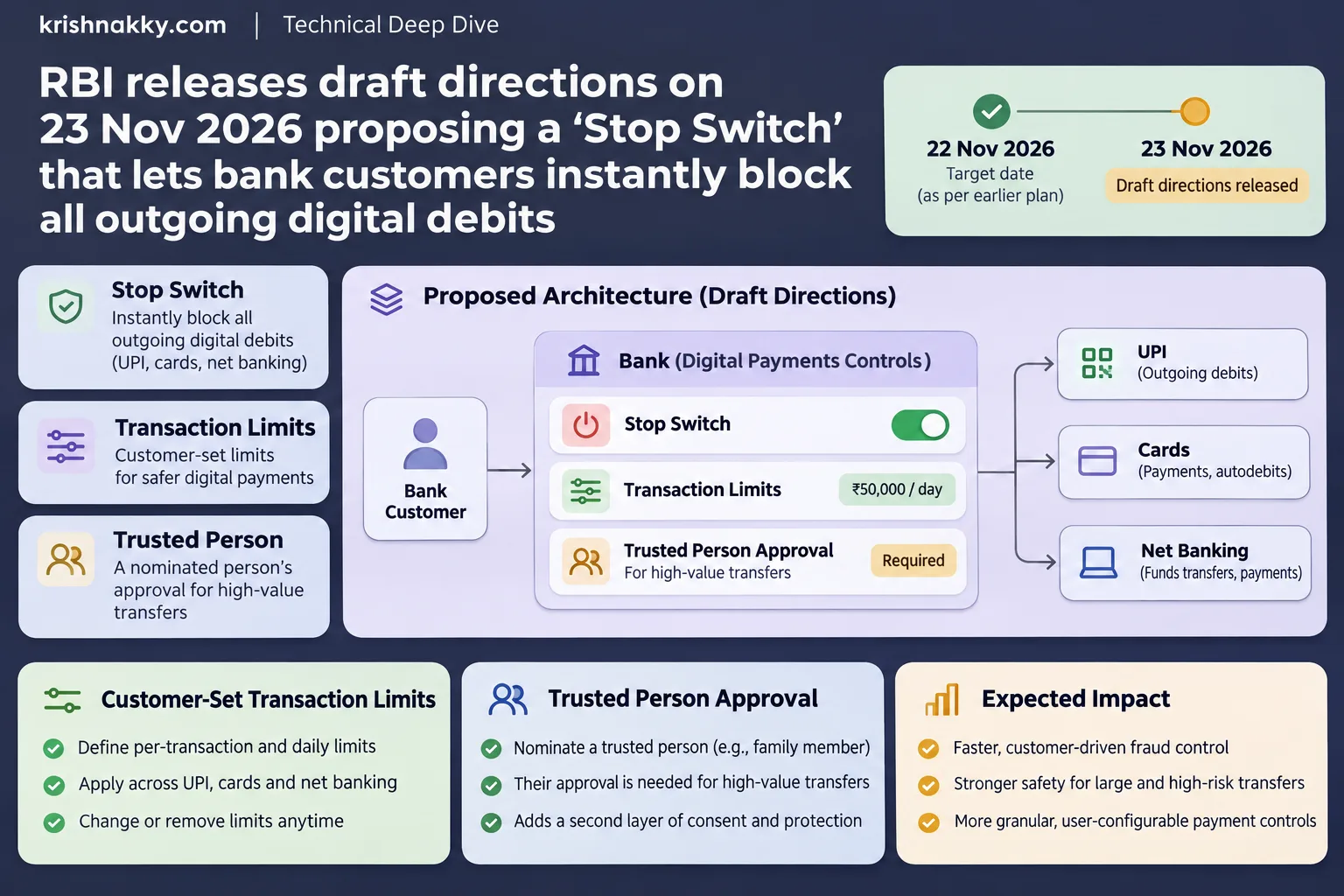
RBI's draft directions, reported on 23 Nov, propose a "Stop Switch" that lets a customer instantly freeze outgoing digital debits, plus customer-set transaction limits and a Trusted Person who must approve high-value transfers (Business Standard, Upstox). This is a draft: it is open for comment, and thresholds, scope and dates may change before final directions.
Most coverage treats this as consumer protection. My angle is different: fraud control moves from "the bank detects it" to "the customer holds the kill switch," and the engineering cost lands on whoever runs the authorisation backends.
"Block everything" is a distributed-systems requirement
A customer taps one button, and card, IMPS, net banking and ATM debits are meant to stop. Those are different rails, with different timeouts and, in many banks, different teams and vendors. Each rail today has its own idea of "is this account allowed to pay."
The obvious implementation is a flag check added to each rail. The risk is that every copy reads its own cache, refreshes on its own schedule, and fails open or closed depending on who wrote it. A card authorisation approved just before the customer hits Stop can still settle, and the customer then disputes whether the switch "worked." That is a plausible failure mode, not something the draft describes.
A safer design is one authoritative, customer-level debit-block state, owned by a single policy or entitlement service that every in-scope authorisation path consults before it commits money. Not a copy of a flag on each rail, but one decision point. If you have built pre-trade risk checks for a broker, it is the same shape: one gate that every order path goes through. I covered that pattern in the SEBI MTF leverage cap piece.
The race with in-flight transactions is the real spec
The draft's headline is the switch. The engineering is the boundary: what happens to a debit that is mid-flight when the state flips? You need a defined cut-off, a monotonic version on the block state, and idempotent state changes, because users will press the button repeatedly on a bad network. You also need an append-only audit ledger of every toggle: who triggered it, from which channel, and which transactions it did or didn't catch. That ledger is what you will be handed in the first complaint hearing.
Exemptions decide the real scope
Independent reports say the Stop Switch leaves existing recurring mandates and bank-initiated loan recoveries untouched, and that new mandates and standing instructions are blocked while the switch is on. If so, the EMI-bounce risk is small, and the engineering question is narrower: the policy service must tell a pre-existing mandate debit apart from a fresh customer-initiated one, and the rules for that distinction need to be written down and tested. Final wording could differ from the reports, so check the draft text itself.
Trusted Person adds a consent workflow
Approval by a second person needs a workflow engine, notification delivery, expiry, revocation, delegation and a consent record for each relationship. It also adds friction at moments when someone is already stressed. The edge cases (the Trusted Person is unreachable, or the relationship is abusive) are likely to be harder than the happy path.
Reports say the Trusted Person check does not apply to UPI, merchant or recurring payments, so the main design question is which channels and amounts it covers and how banks present that clearly to customers.
What I'd watch
Three things decide whether this works. First, added latency on any authorisation path the switch does touch. Second, false-lock abuse: a hijacked app or a coercive family member freezing someone's money is a real attack, so recovery and verification flows matter. Third, how the exemptions are written and tested.
My view: banks that already run a central entitlement service should find this easier than banks with separate checks on each rail, which will spend longer reconciling races and audit findings. I haven't measured any bank's timeline, so treat that as judgment. If you build payments backends, consolidating your authorisation decision into one place is worth starting now, and the draft's comment window is a chance to flag the in-flight and exemption questions above to RBI.