Tata Sons Is a Listing Fight. For Engineers, It's a State-Machine Lesson
RBI's 16 Nov letter tells Tata Sons to follow upper-layer NBFC rules, listing included. Why compliance for lenders and payments firms should be modelled as a classification engine.
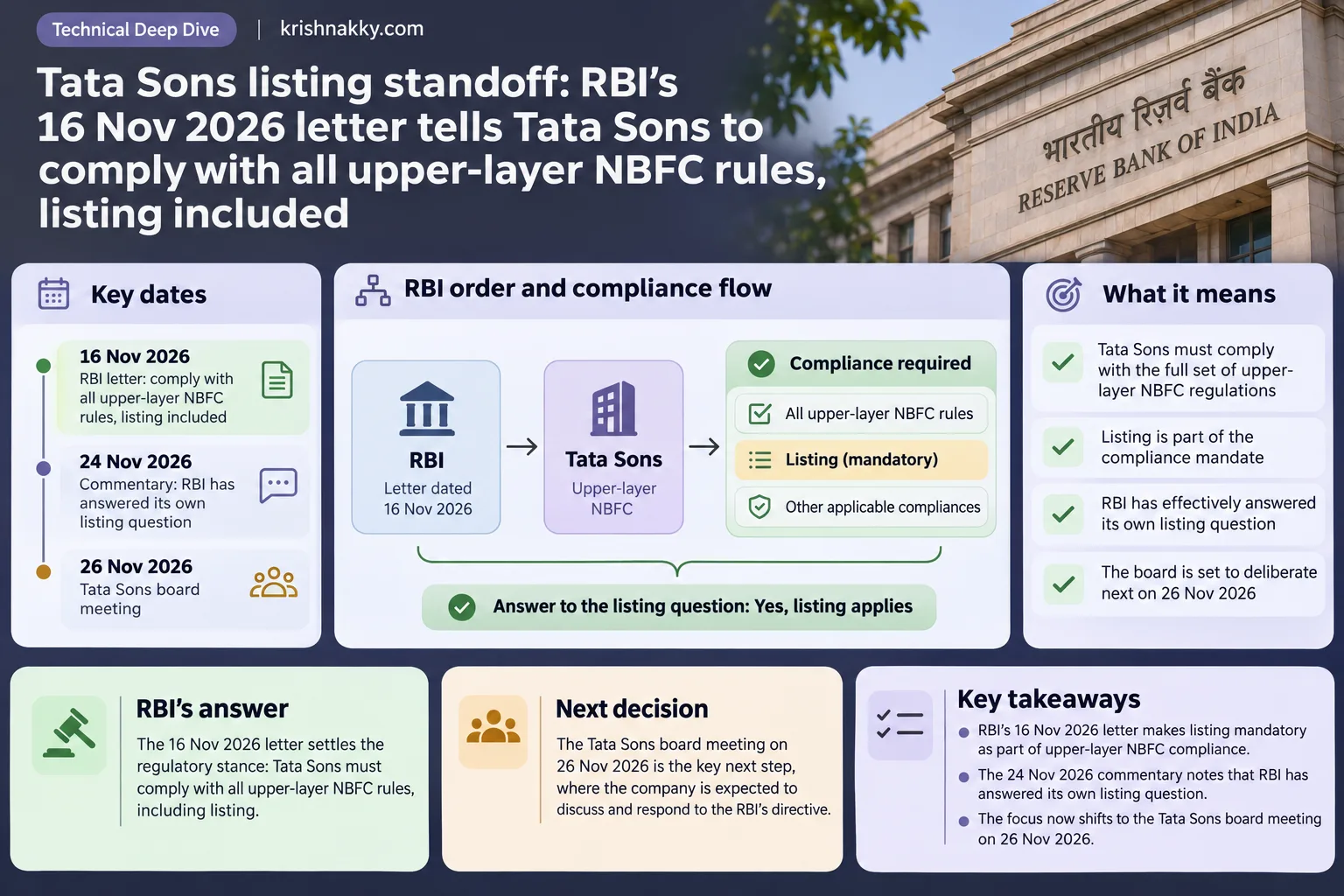
RBI wrote to Tata Sons on 16 Nov telling it to comply with every upper-layer NBFC rule, listing included, and Business Today's report says the regulator has made its stand clear again. The Tata Sons board meets on 26 Nov. What blocks the listing today is the status question: RBI has rejected the Core Investment Company deregistration, and a restructuring proposal is still pending.
Most coverage reads this as a boardroom story: promoters against regulator, public float against privacy. This note takes a narrower angle. It is a governance item first, and the engineering interest is in how the classification rule is built.
Upper-layer status is rule-driven, not negotiated
Under the scale-based framework, the upper layer is set by a published scoring methodology, with size and interconnectedness weighing heavily, though RBI keeps supervisory discretion. A published list records the result. Once you're on it, listing and disclosure duties attach to you whatever the promoters would like. The Moneylife report frames the public float as back at the centre of the dispute, and that tells you where the leverage sits: the entity has to argue its way out of a classification, not argue its way in.
That is how a rules engine behaves. Inputs go in (balance sheet size, group exposure, entity type), a layer comes out, and obligations follow from the layer.
The dispute maps onto status transitions
Look at what the dispute is actually about. Crossing the ₹1 lakh crore line is a transition. A request to deregister as a Core Investment Company is a transition that was requested and rejected, and it is the status the dispute turns on. Reassignment from one layer to another is a transition with its own effective date. Even Tata Sons asking RBI for guidance in October, as Free Press Journal reported, is an event on a timeline that someone will later have to reconstruct.
A common way to handle this is a legal memo and a spreadsheet. That breaks when the status flips, because the questions are blunt. Which obligations switched on, from which date, who signed off, and which systems were still treating you as the old layer?
What I'd build, and what I wouldn't
If I ran engineering at an NBFC, a lending startup growing toward a threshold, or a payments company with a licence ladder, I'd want these things first-class:
- A regulatory status that is stored, versioned and dated, not inferred from a config flag.
- Thresholds that are data, with the metric that feeds them computed the way the regulator computes it, on the regulator's reporting date.
- Pending applications such as deregistration requests modelled as real states, so "under examination" is a recorded fact and not a hallway rumour.
- An audit trail that lets you replay what you believed your layer was on any past day.
I'd not bury any of it in scattered if statements in the reporting job, where a threshold ends up duplicated and one copy goes stale. The SEBI MTF cap piece makes the same case about a single gate for a threshold rule.
Tata Sons is unusual, the pattern is not
The popular read is that Tata Sons is special, an unusual holding structure with unusual history. That is true of the CIC question. The threshold mechanics are generic: any entity that grows will meet a line like this, and a published threshold is easy to test against your own numbers.
I can't tell you how the 26 Nov meeting will go. One letter to one entity doesn't show a regulatory trend. It does show that a classification can be tested against published criteria, so a firm near a threshold can't assume it will get notice first.
My view: if your product can cross a regulatory threshold, build the classification engine before you need it. The cheapest time to model the transition is the quarter before you're in it.