Sarvam's Token Factory Is an Inference Margin Business, and That's Fine
Sarvam's Token Factory sells inference on Indian GPUs, mostly for Chinese open-weight models. What fintech teams should check: data residency, SLAs, margins.
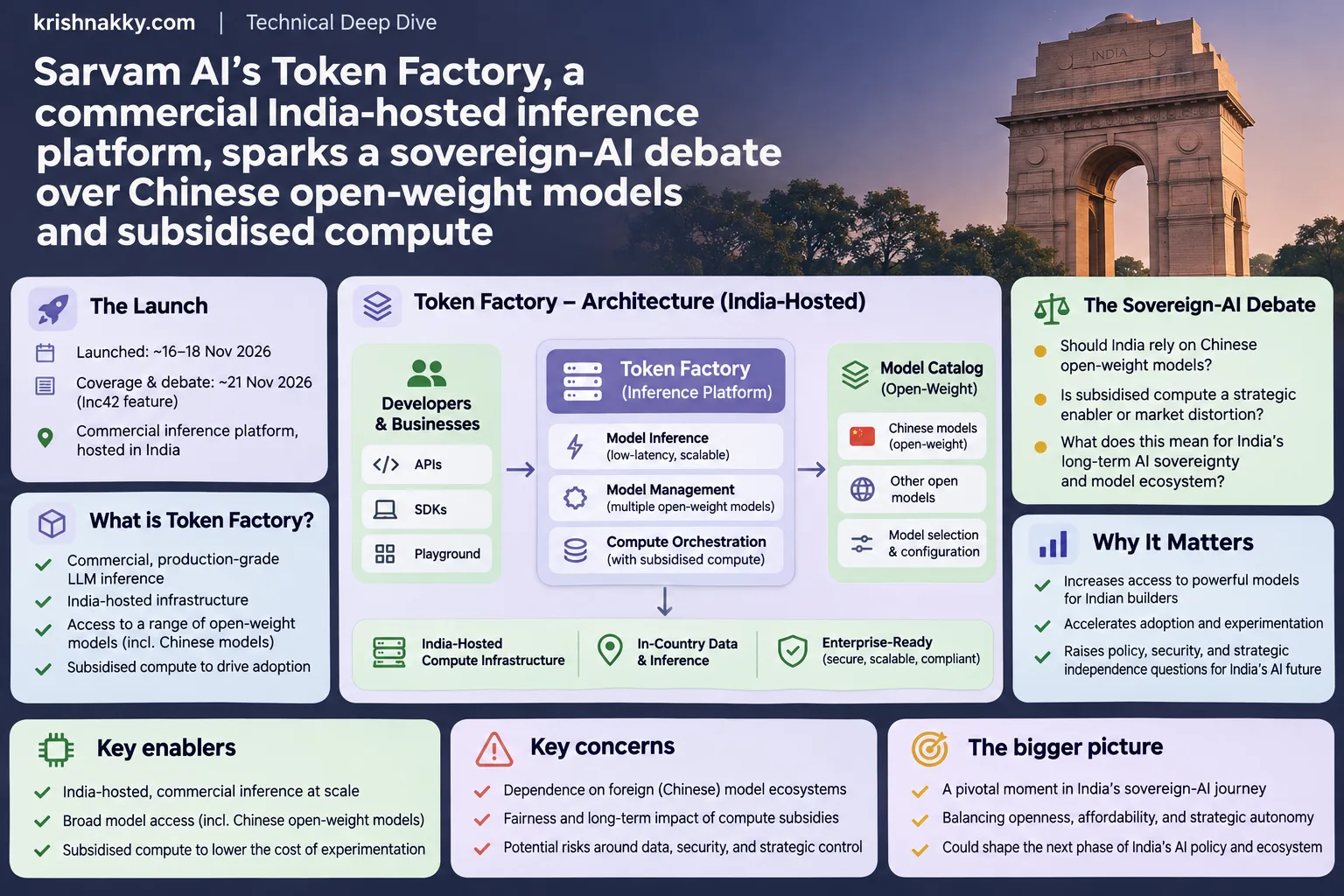
Sarvam AI launched Token Factory around 16 November, a paid inference platform running on GPUs in India. Most of the eight models it hosts come from Chinese labs, which set off a fresh argument about what "sovereign AI" means. Inc42's feature and the Analytics India Magazine piece cover the backlash well. I want to look at it from the side of someone who has to put this behind a production system.
Residency matters more than provenance, for most buyers
Most of the heat is about provenance: why is a company tied to the IndiaAI Mission selling DeepSeek? I think that's the wrong first question for most buyers. Sarvam's DeepSeek V4.1 Flash endpoint is listed at ₹14 per million input tokens and ₹55 per million output tokens. Sarvam's docs call that introductory pricing, running through the end of 2026, so it isn't yet a stable going rate. The likely draw at that price is that the prompt, and the customer record inside it, stay on a machine in India.
If you build for a bank, a broker or a payments company here, the first audit question I'd expect is "where did the data go?" Open weights run on infrastructure you can point to are a different risk from a closed API in another jurisdiction. Provenance can still come up, though. RBI and SEBI may care about model provenance for regulated workflows, and I haven't seen either regulator spell out a position on hosted open-weight models. Ask your compliance team before assuming it won't matter.
Latency is the other argument. An Indian region should beat a round trip to Virginia, which matters near an order flow or a customer chat. I haven't measured it and Sarvam hasn't published numbers, so benchmark p50 and p99 from your own network before relying on it.
Provenance also carries operational risks: poisoned or quirky weights, licence changes, a lab that stops publishing. Those are model-governance problems and you handle them with evals and pinned versions.
What I'd actually want to see
Sarvam says it processes 450B+ tokens a day. As I read it, that figure covers DeepSeek V4.1 Flash only, and about 95.7% of prompt tokens were served from cache. Cached tokens are cheap to serve, so the count says little about utilisation or revenue. No one has audited it. Sarvam claims India's largest B200 cluster, but I found no published GPU count, only the claim. I also haven't seen how much traffic is billed at full price rather than given away or discounted, and that number decides whether the business works.
Margin is what I'd check first. Sarvam's side says it procured the GPUs privately and that subsidised access has ended. I can't verify that, and the Forbes piece on its pricing against DeepSeek shows how thin the pricing room is when everyone serves the same open weights. MediaNama is worth reading on the sovereignty framing. When the model is a commodity, the winner is whoever keeps the GPUs busiest and the p99 tight.
The Java engineer's checklist
If I were evaluating this for a Spring Boot shop, the OpenAI-compatible API is the best feature. It means Token Factory can sit as one more backend behind an existing LLM gateway, with a base URL and a key to change. I could route sensitive traffic to Sarvam and keep other traffic elsewhere, then fail over between them.
But a drop-in API doesn't tell me what I need to put it in front of customers:
- A written SLA, not a marketing page.
- Rate limits stated per key and per model, with clear behaviour on 429s.
- Provisioned or reserved capacity, so my morning peak doesn't queue behind someone's batch job.
- Notice before a hosted model is retired or swapped.
- What "zero data retention" means in the contract.
For an engine that handles money, the gateway needs a circuit breaker and a fallback path anyway. I'd treat Sarvam as a tier, never as the single dependency. I wrote about the same concentration problem in the Anthropic IPO piece.
What the launch signals
Part of India's AI conversation is shifting from "who builds the biggest model" to "who runs inference at a profit." Building a frontier model and running a good inference service are different businesses, and Token Factory suggests Sarvam is leaning on the second to pay the bills today.
My view: Token Factory is worth a pilot behind a gateway for non-critical traffic. Before it takes anything customer-facing, I'd want audited utilisation, written SLAs and unit economics that hold once introductory pricing ends. None of those can be checked today, so I wouldn't commit yet.