SEBI's Free-Float MTF Cap Is Really a Pre-Trade Risk Engine Problem
SEBI is weighing per-stock margin trading limits tied to free float, with no decision yet. The hard part sits inside broker risk engines: real-time concentration checks, stale float data and intraday edge cases.
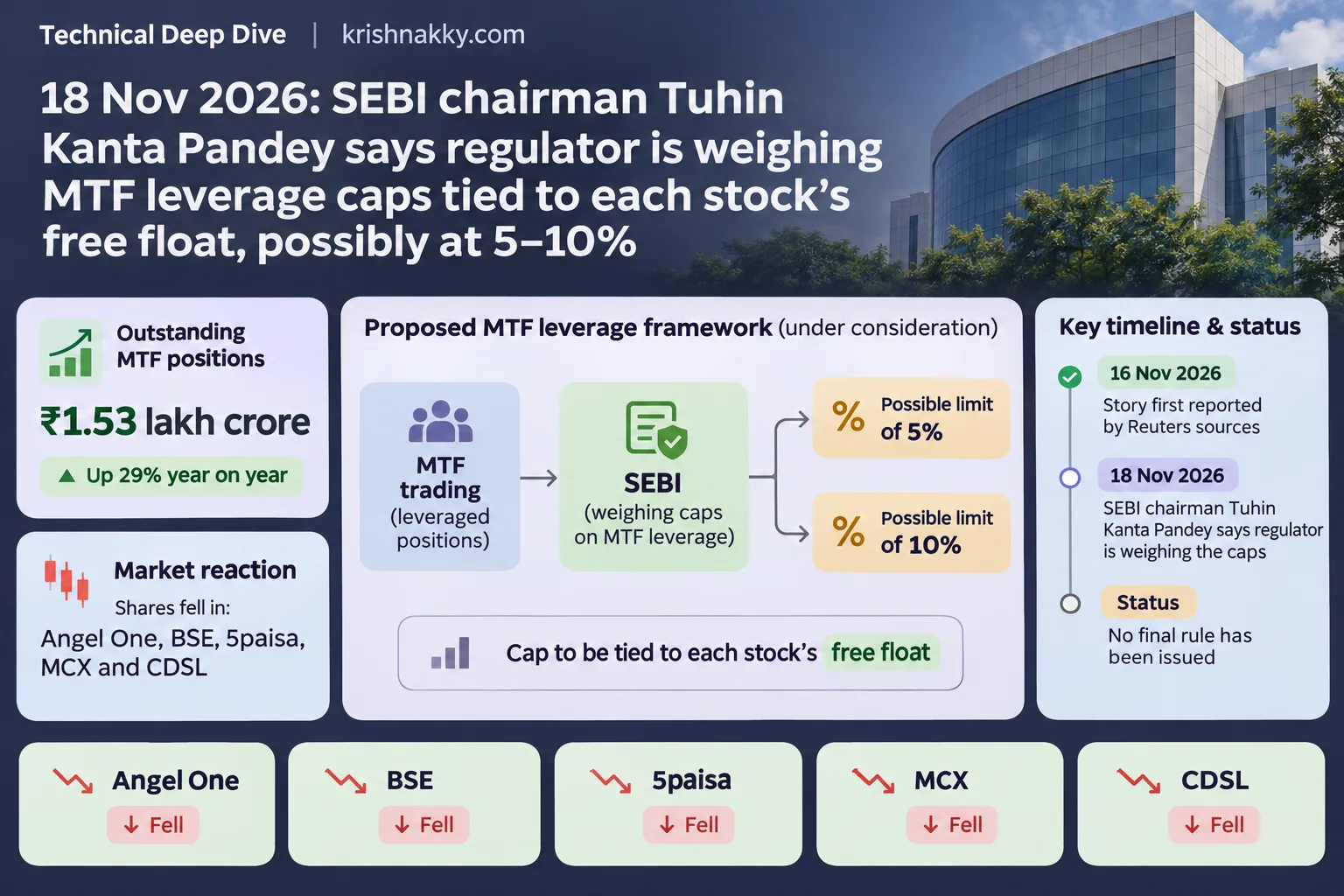
On 18 Nov, SEBI chairman Tuhin Kanta Pandey said the regulator is looking at tying margin trading facility (MTF) limits to each stock's free float, with figures of 5–10% floated in the Reuters-sourced reports. Outstanding MTF is about ₹1.53 lakh crore, up 29% year on year, and Angel One, BSE, 5paisa, MCX and CDSL all fell. To be clear, SEBI has not decided on a limit, and it says it will consult the public first.
The reports so far focus on the stock reaction. I care about a different question: what would a broker actually have to build?
The cap is per symbol, so the check is per symbol
A cap on total MTF is a single number you can watch on a dashboard. A cap on margin-funded holdings as a share of each stock's free float is a different kind of check. Roughly 220 stocks already sit above 5% and 36 above 10%, per the market coverage. The reports don't say how the limit would be enforced, so this is my reading of what a broker would need. For each MTF buy order, it would have to know the aggregate margin-funded quantity in that symbol across its client base, compare it with a free-float share count, and decide before the order goes out.
That is a shared counter that every client session touches. If it is refreshed by a batch job, it will lag intraday. If it is updated on fills rather than orders, it also has to roll back on rejections and partial fills. Brokers already run exposure and SPAN margin checks, but those are keyed on the client, not on the symbol across all clients. I haven't seen any broker say whether it has a symbol-level check.
Where a build could go wrong
Stale free-float data. Free float is not a constant. It shifts with promoter pledges, block deals, lock-in expiries and index rebalances. If the denominator comes from a monthly file, the broker will block orders that are fine and allow ones that are not. Someone has to own that data feed and its revision history.
Existing positions. Day one of any rule, some stocks are already over the line. Do you freeze new buys, force sells, or grandfather? Each choice is a different code path, and forced liquidation of a crowded small-cap is exactly the volatility the rule is trying to prevent.
Intraday. MTF positions are carried, but clients also churn intraday. Is the limit measured at order time, at end of day, or both? Measuring at order time with a race between two clients buying the last slice of headroom is how you get a support queue full of "why was I rejected but he wasn't".
Who enforces it. The reports don't say whether the cap would be measured per broker or across the market, or whether the exchange or a depository would enforce it. If it is per broker, each firm can check its own book. If it is market-wide, no single broker sees the full margin-funded share unless the exchange or depository publishes a consolidated figure. That choice matters more than the percentage.
What it means for algo and quant desks
If a strategy buys margin-funded size in a small-cap where MTF already exceeds 5% of free float, a cap at that level could mean new orders get rejected. Backtests that assume you can always add margin-funded size in such a stock would overstate what is achievable, so model rejections as a possible outcome.
The revenue point
Angel One earns real money from margin-funding interest, and BSE depends on volumes. Jefferies, as reported, thinks only about 4% of the book sits above 10% of free float, but about 23% would be caught at 5%. The share price reaction was a bet on which threshold SEBI picks, and the niftytrader write-up shows how fast a chairman's remark moved those stocks.
My view: the percentage is the easy part. The firms that have per-symbol, fill-accurate, real-time concentration checks in their order path will have the easiest time adapting, whichever threshold SEBI picks. The ones relying on end-of-day reports will spend the consultation window finding out how far behind they are. Start building the check now, because the rule will arrive faster than the data does.