Soket AI's $4M Comes From a Lender and a Bank-Software Vendor
Bajaj Finserv and Pennant put about $4M into IndiaAI-backed Soket AI. My read: its likely first customers are banks, so inference location and audit trails matter.
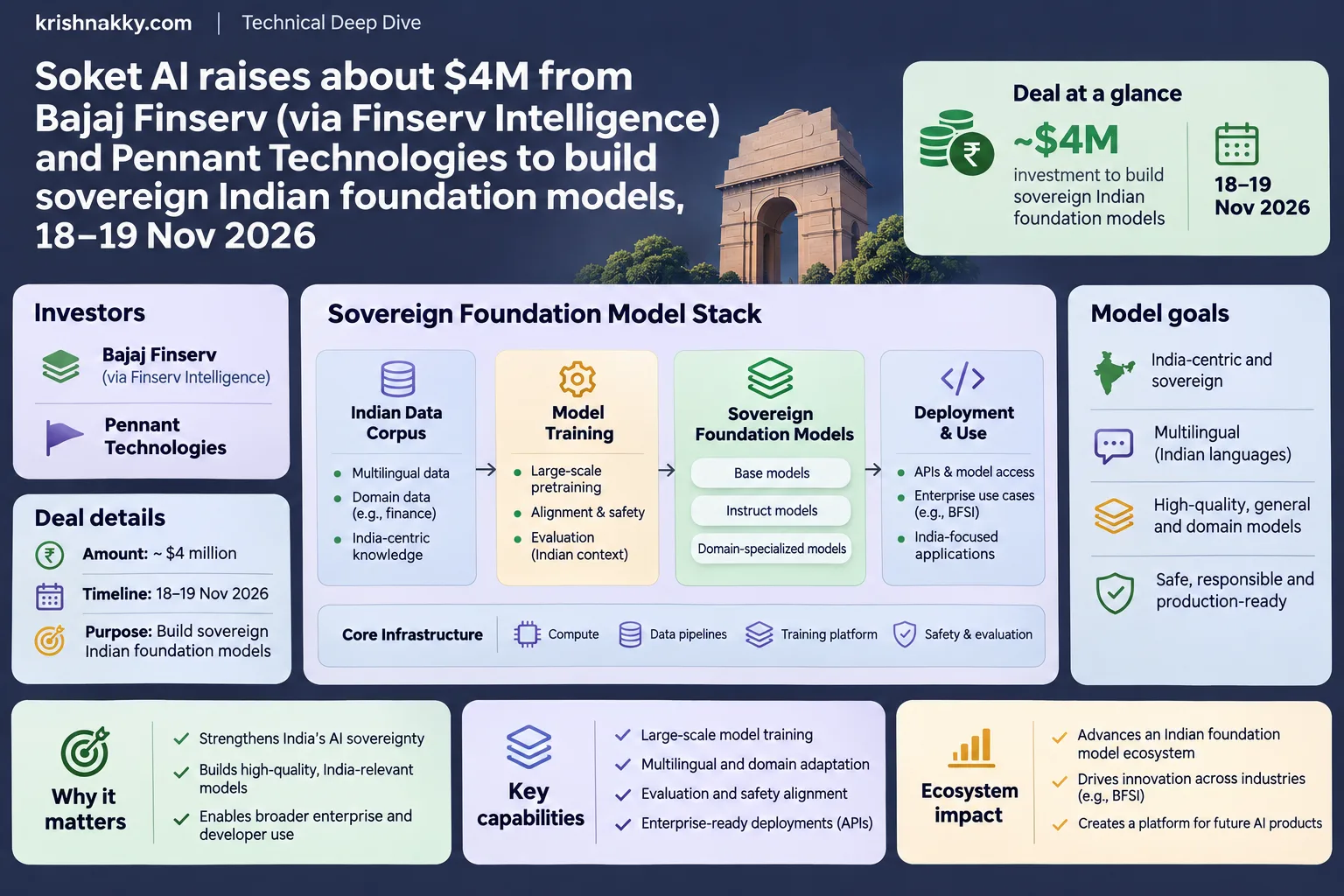
Soket AI, a Bengaluru lab building Indian foundation models under the IndiaAI Mission, has raised roughly $4M, with Bajaj Finserv (through its Finserv Intelligence arm) and Pennant Technologies the main cheque-writers and Finvolve and India Accelerator also in the seed round, per YourStory's report. Pennant says it will use the models in banking agents for things like onboarding, document processing and collections.
Four million dollars won't train a frontier model. Nobody serious thinks it will. The useful signal is who paid. Soket's EKA-1, a 26B-parameter model, is the thing they're backing.
Likely customer money, not VC money
A large lender and a vendor that sells core software to banks are not betting on a lab's valuation. They're buying a seat at the table for the thing they expect to deploy. This is my inference, not something either company has said: I read it as buyers securing early access. One detail sharpens it. Business Standard reported that Bajaj Finance holds roughly 26% of Pennant, so this looks like one related group on both the lender and vendor side, not two independent bets. If I'm right, "sovereign AI" in India isn't going to look like a national chatbot. It's going to look like a model that sits behind a collections workflow in a lending stack.
That matters, because the pitch to a bank is different from the pitch to a consumer. Nobody in a risk committee asks whether the model is impressive. They ask where inference runs, who can see the prompts, and what happens when a regulator asks why a customer got a particular message.
What I'd ask if I were running a Spring Boot bank stack
On Java services I've worked on, audit and data-residency requirements, not model quality, decided vendor choices. Soket hasn't published hosting or deployment details I could find, so this is my checklist for any vendor here, and the RBI's data localisation rules for payment data and its IT outsourcing and model-risk expectations are why it matters:
- In-country inference, provably. Not "our region is Mumbai" in a slide. I want to know that prompts, embeddings and logs never cross a border, including in the vendor's own observability tooling.
- Auditability per decision. An agent that drafts a collections message is making a regulated customer-facing action. I need the input, model version, and output stored in a form someone can replay months later. Model versions drifting silently under a stable API name is the failure I'd worry about most.
- Small and tuned versus rented and huge. A model that's good at math, code and structured reasoning, and runs on hardware the bank controls, could beat a frontier API on cost, latency and compliance even if it loses on raw capability. That's a hypothesis; nobody has shown EKA-1 doing it yet.
- A failure story. What does the agent do when the model is down or wrong? In a payments or lending path, the answer has to be a boring fallback, not an apology.
Renting one frontier API for core workflows is a concentration problem, which I wrote about in the Anthropic IPO piece. A domestic option gives a bank a second source.
Where I'm skeptical
The IndiaAI selection and a funding headline prove nothing about production. Pennant also has an obvious incentive to talk up the models it now has a stake in, so I'd treat the announced use cases as intent, not results.
Four million is also thin when serving, fine-tuning and evaluation all cost money every month, not once. If the lab is partly funded by its first customers, the risk is that the roadmap bends toward whatever those customers need this quarter. That could be a feature, since it keeps the work grounded. It could also quietly narrow the lab into a bank-software component.
My read
Indian sovereign AI is turning financial-services-led and enterprise-first, and I think that's the more honest path than chasing a general-purpose rival to US labs on a startup budget. But I won't count it as a success until a named bank runs a Soket-powered agent in a live workflow, with audit logs a regulator can read and inference that stays on Indian soil. Until that ships, this is a promising bet, with no result yet.