Urban Company's ₹2,500 Crore QIP: What the ₹600 Crore for InstaHelp Has to Fix
Urban Company opened a ₹2,500 crore QIP at ₹161.03 and earmarked ₹600 crore for InstaHelp's supply side. A production engineer's read of what a 10-minute promise demands from dispatch and matching, and what the company has not said.
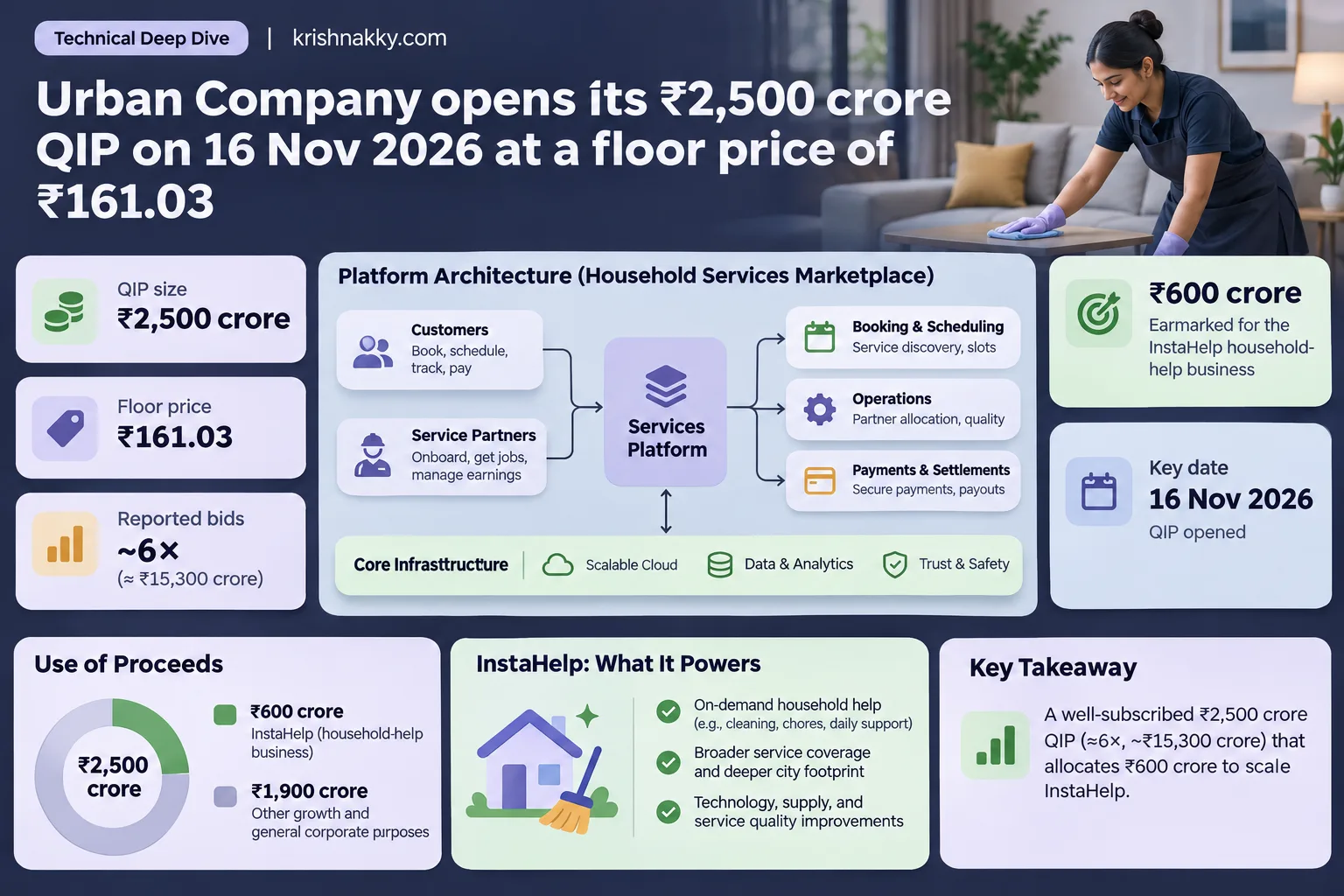
Urban Company, the listed home-services marketplace, opened a ₹2,500 crore QIP on 16 November at a floor price of ₹161.03, and Inc42 reports that ₹600 crore of it is meant for the supply side of InstaHelp, its 10-minute household-help service. Press reports put the bids at roughly 6x the issue size, about ₹15,300 crore. The issue closed on 19 November. The final issue price is unconfirmed, and one report mentions ₹156 a share.
Why the ₹600 crore matters more than the 6x
Most coverage fixates on the 6x. I care more about the ₹600 crore, though I should be clear about what is known. Reports describe it as funding the "supply ecosystem", which means worker supply. Nothing I've seen from the company says it goes to dispatch software, and I have no evidence of how InstaHelp's allocation works internally. What follows is my engineering reading, not reporting.
A 10-minute promise is not a product feature. It's a dispatch problem with a deadline. Someone has to be within a few minutes of the customer, already verified, already trained, and free at the exact moment the order lands. You can't fix that in the app. You fix it by keeping enough idle, well-placed workers in each micro-zone, and idle workers cost money whether or not an order shows up.
So most of the ₹600 crore is probably worker onboarding, training, incentives and the cost of idle time. Whatever share goes into software is likely the smaller part. The engineering questions sit underneath that spend:
- allocation that decides, per order, who gets it and what that does to the next order;
- routing built around an SLA, where a late arrival is a failed order and not a slow one;
- onboarding, training and background verification, which is the slow, human part of the stack;
- a trust layer, because you're sending a stranger into someone's home in under ten minutes.
Those are the parts that fail first when order volume spikes, and none of them are visible in a demo.
Why the loss per order is the real story
Inc42 reports a loss of about ₹447 per InstaHelp order. I haven't checked that against filings, so treat it as their number. Even as a rough figure it tells you something. When a dispatch system loses money per order, the fix is rarely "more marketing". It's utilisation. How many orders does each worker complete per shift? How tight is the batching? How often does the system send someone across a neighbourhood because it matched greedily instead of globally?
Those numbers decide whether this business reaches profit. The raise buys time to work on them, but it doesn't change them by itself.
What the QIP mechanics add
A QIP prices against a floor, so institutions bid knowing where the discount starts. Heavy oversubscription means demand was strong at that floor. It doesn't tell you the unit economics are solved or why any given fund bid. I wouldn't read much into a one-day share move either, and I haven't seen consistent figures for how the shares traded during the issue.
What this means if you're building something similar
If your product promises a time window, your real product is the allocation engine and the people behind it. Budget for that first. Snabbit and Pronto are reported to be chasing the same quick-service promise, though I haven't found sourced figures for either, so I won't compare scale. The likelier winner is whoever raises utilisation while keeping quality steady, not whoever spends most on ads.
My view: the ₹600 crore will look well spent only if InstaHelp's cost per order falls as the network densifies. If the money goes mostly into acquiring customers while the dispatch layer stays the same, the loss per order won't close, and this won't be the last raise.