The US Just Turned GPU Export Control Into a KYC Problem
BIS's interim final rule (announced 15-16 Nov 2026, effective 19 Nov) requires licenses for giving Chinese-headquartered firms remote access to advanced AI chips. A fintech-minded engineer reads it as an AML-style metering and ledger problem for data-center operators.
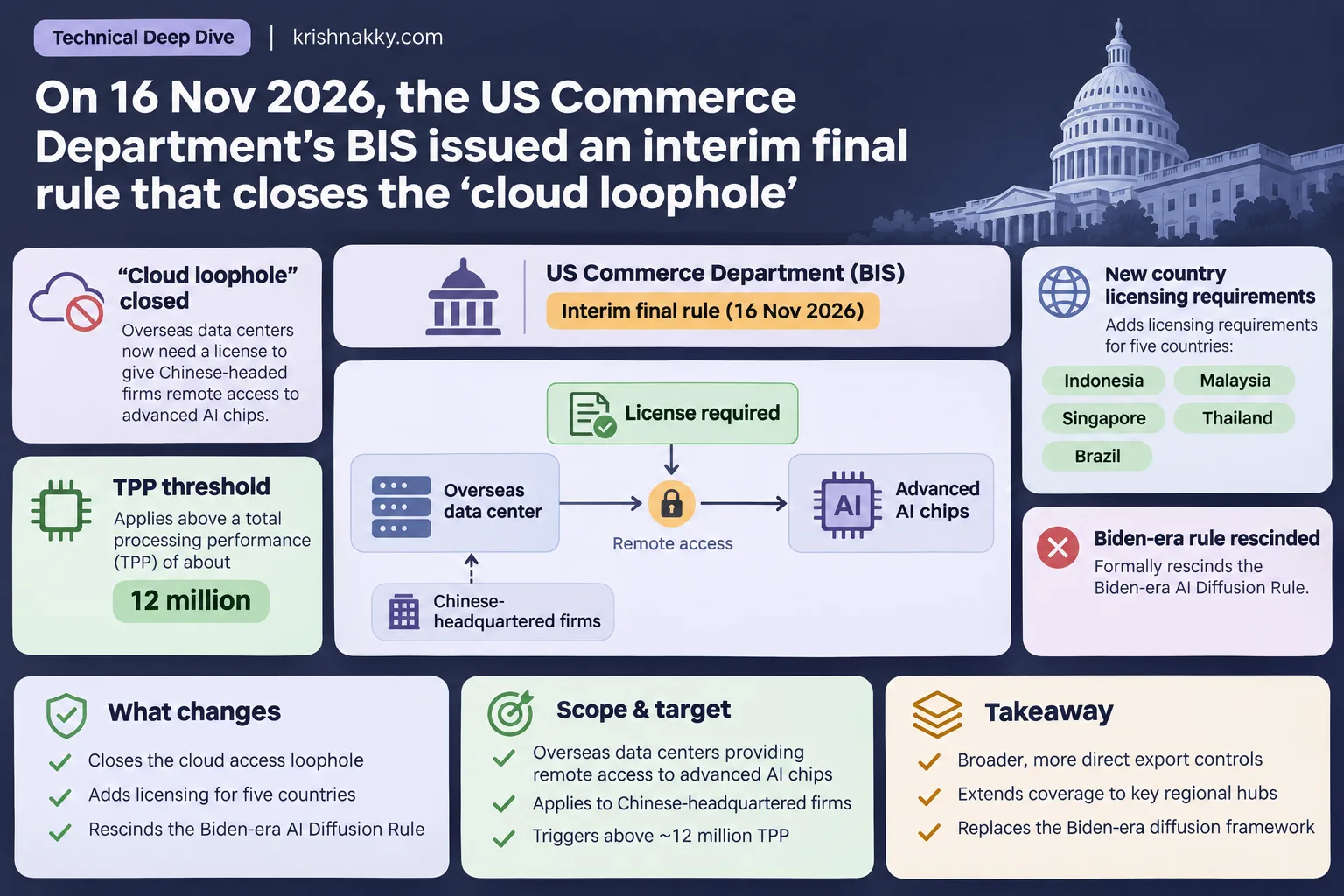
The US Commerce Department's BIS issued an interim final rule closing the "cloud loophole": overseas data centers now need a license to give Chinese-headquartered firms remote access to advanced AI chips above a TPP threshold of roughly 12 million, aggregated across linked data centers (Unite.AI reports the aggregation). Sources disagree on the announcement date: WilmerHale says 15 Nov, Latham and Squire say 16 Nov. The rule is effective 19 Nov, which is the date operators should work from. It also adds licensing requirements for Indonesia, Malaysia, Singapore, Thailand and Brazil, and formally rescinds the Biden-era AI Diffusion Rule. (TechCrunch has the headline version.)
This is an interim rule with a 60-day comment period closing in January 2027, so the details may change. What follows is my unverified commentary, not legal advice, and I haven't checked the EAR § 744.24 mechanics or the definition of "headquartered" against the rule text.
From shipments to usage records
Old export control was a physical event. A box of GPUs leaves a warehouse, a customs record exists, someone checks a destination. You can audit that with paperwork.
Now the controlled thing is a relationship: who is renting which accelerators, from where, for how long. That isn't a shipment. It's a stream of usage events tied to a customer identity, and the identity has to be resolved to a headquarters country. If that sounds like AML, it should. The Latham and Ashurst alerts cover legal scope and compliance obligations. What they don't spell out is the system design: what an operator's onboarding and metering stack has to do when a new tenant signs up.
What the system actually needs
Here is how I'd map it, using payments-style controls (UBO checks, structuring detection, append-only ledgers) as the analogy. It is my own mapping, not something the rule prescribes:
- Customer identity with beneficial ownership. "Chinese-headquartered" is not a dropdown field. A Singapore shell owned by a Shenzhen parent is the standard fact pattern. This is the same problem as ultimate-beneficial-owner checks in onboarding, and it is never solved once. It drifts when ownership changes.
- Aggregation, not per-order checks. A threshold on compute means you must sum usage across jobs, clusters and sub-accounts, then across related customers. That is a real-time aggregation engine, the same shape as structuring detection. Ten small tenants that are secretly one buyer should trip the same wire as one big one.
- Immutable usage records. If a regulator asks what a tenant ran in March, "we rotated the logs" ends the conversation. You want append-only metering you can replay, with identity snapshots versioned alongside it. Mutable billing tables won't survive an audit.
- Reconciliation for reporting. The searches I ran only turned up reporting requirements for shipments to U.S.-headquartered companies, not a confirmed monthly cycle for remote access. If reporting does apply, the meter must tie to what was invoiced and what was reported, and breaks need an owner.
Who likely hurts
My guess, not sourced: smaller operators feel this more than hyperscalers, who tend to run large compliance and identity teams. That would put the burden on mid-size data centers and GPU resellers, especially in the five named countries. Many sell through resellers who sell through other resellers, and a billing stack built to charge per GPU-hour doesn't prove who was behind the hour.
A reseller chain is also a compliance data-loss pipeline. Every hop that strips identity from the record is a hop where you can no longer answer a regulator. One plausible response is contractually requiring pass-through customer data, and operators that can't get it may decline the grey-area segment. That is a prediction, not something I've seen reported.
What I'm unsure about
The grace period for existing data centers is reported inconsistently: The Next Web and other coverage disagree on whether it's 90 days or a fixed 17 Feb 2027 date. Treat it as unconfirmed until the Federal Register text settles it. I also haven't seen the rule's definition of "headquartered" tested against real ownership chains, and that definition is where most of the engineering pain will live.
My take
Identity, metering and audit trail now belong in core infrastructure, not bolted onto billing. If I ran a Southeast Asian GPU cloud, I'd stop selling to anyone I couldn't resolve to a beneficial owner within a day, and I'd build the immutable usage ledger before I signed another reseller. Operators that do this early should be easier to defend in a license review than those that don't.