SEPA Instant for Non-Euro PSPs: 9 Jan 2027 Blueprint
Non-euro EU banks must receive SEPA Instant payments by 9 January 2027. See the Spring Boot blueprint for the 10-second budget, idempotency and pacs.002.
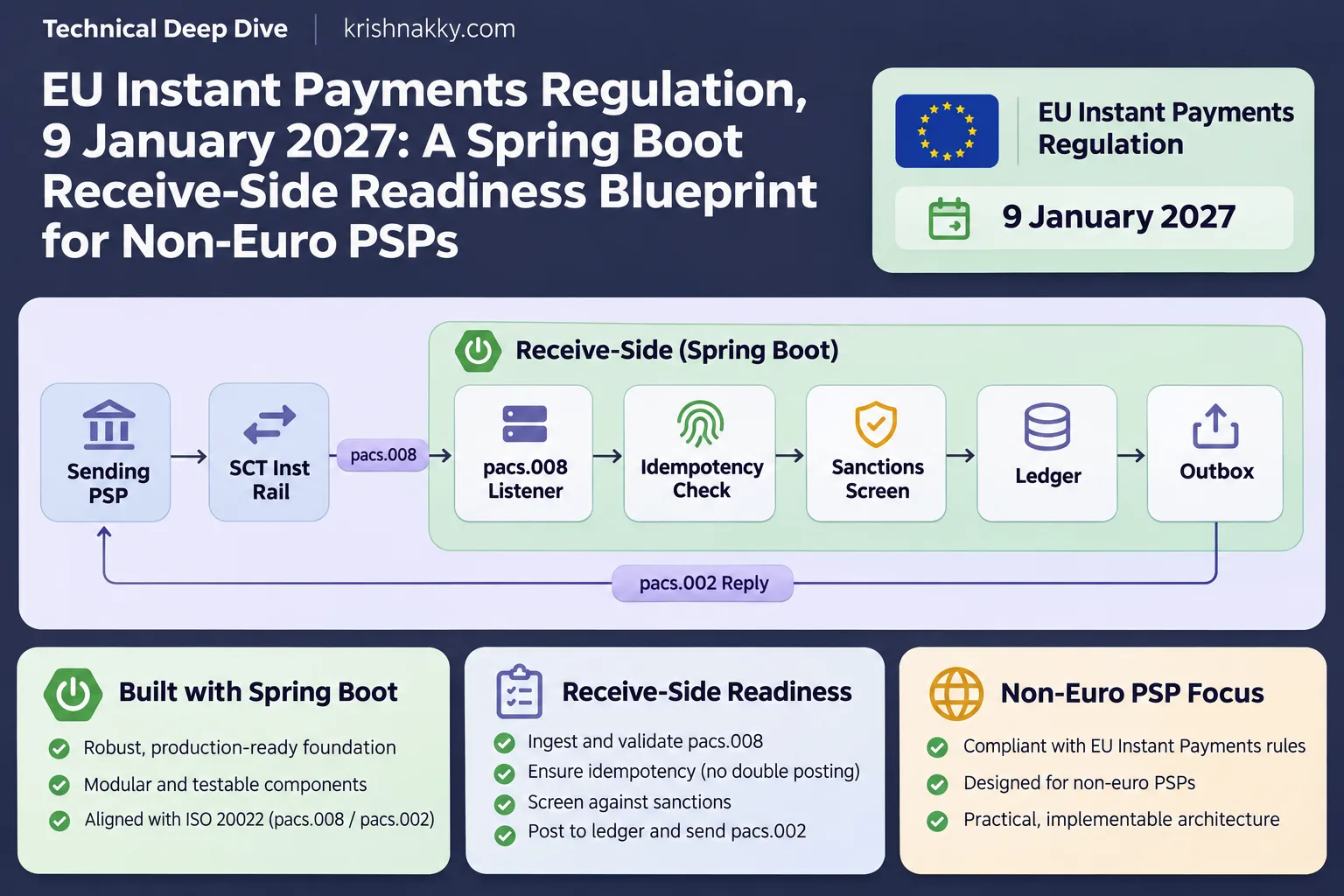
Banks in EU countries that keep their own currency, such as Poland, Romania, Sweden and Czechia, must be able to receive SEPA Instant (SCT Inst) euro payments by 9 January 2027, with each transfer finished inside a 10-second scheme limit. Reading the regulation and the scheme rules left me with a blunt view: the XML is a one-week job, and the clock is the real project. Nobody remembers the week you wired up the pacs.008 parser. They remember the Saturday night when the core ledger was in its end-of-day posting run, every credit sat behind a table lock, and a few hundred payments timed out in a row.
This post is written for engineers at banks and payment institutions that already know what a PSP and a CSM are. It goes straight to the receive path: the deadline table with article references, a time budget with its reasoning shown, idempotency, the pacs.002 reject-code map, liquidity, screening and FX, then availability.
What the regulation asks of the receive side
Regulation (EU) 2024/886, the Instant Payments Regulation, amends the SEPA Regulation 260/2012. The obligations that matter to a non-euro PSP are spread over a few new articles. Check the article numbers against the consolidated text, because I have seen secondary sources cite them loosely:
| Obligation | Non-euro PSPs | Where to read it |
|---|---|---|
| Receive SCT Inst | 9 January 2027 | Art. 5a(1), with the transition dates in Art. 3 of 2024/886 |
| Send SCT Inst | 9 July 2027 | Art. 5a(2), same transition mechanism |
| Verification of Payee (name check) | 9 July 2027 | Art. 5c |
| Daily customer screening instead of per-payment screening | applies with the instant obligations | Art. 5d |
| Out-of-hours sending, certain cases | 9 June 2028 | transition provisions |
There is a known disagreement about payment institutions and e-money institutions. The ECB implementation table I rely on shows 9 January 2027. Vixio and some other commentary show 9 April 2027, and I have seen two versions of the ECB page list different dates. I plan to the ECB and to January for everyone. If you are a payment or e-money institution, ask your national supervisor in writing, and build to January regardless: the engineering is identical, and a later date only gives you slack you should not spend.
One correction to commentary you may meet: Oliver Wyman's overview says non-euro PSPs must send and receive by 9 July 2027. That merges two obligations. Receive comes first.
Underneath the legal text there are four engineering demands:
- Accept a pacs.008 at any time, with no maintenance window.
- Answer inside the time budget.
- Never credit twice, never lose a payment, never send two different answers for one payment.
- Handle currency: the payment is in euro, the customer's account is in złoty, lei, kronor or koruna.
The sender's bank and the clearing system wait for your pacs.002. If it does not arrive in time, the transfer fails and the payer is refunded. From the customer's seat, a timeout is a failed payment.
The ten-second budget, with the arithmetic
The scheme timeout is measured from the originator side, so you never own all ten seconds. Here is how I split them. These are planning assumptions, not scheme figures, and you should replace each with your own measurement from your CSM connection:
| Segment | Assumed share | Why |
|---|---|---|
| Sender's PSP, before it submits | ~2.0 s | Its own validation, screening, funds reservation |
| Hop to CSM and on to you | ~1.5 s | Two network legs plus CSM routing |
| Your service | ~4.0 s | The part this post designs |
| Reply back through CSM to the sender | ~1.5 s | Same two legs in reverse |
| Margin for jitter and clock skew | ~1.0 s | Nobody should plan to 10.000 s |
That is where my four seconds comes from: what remains after pessimistic estimates for everyone else, with a margin I refuse to spend. If your CSM link has a measured round trip of 400 ms, your figure goes up. If your sender-side partners are slow, it goes down. The point of writing it as a table is that you can argue with each row.
Inside my 4 seconds, stage caps are set from measurement on a test rig, not picked as round numbers. The caps below are where I would start, then adjust to your own p99 under load:
| Stage | Starting cap (ms) | If it overruns |
|---|---|---|
| Parse and validate pacs.008 | 100 | Reject (format reason) |
| Idempotency claim | 50 | Fail closed: retry once, then reject |
| Account lookup and status | 150 | Reject (account closed or unknown) |
| Sanctions / risk decision | 800 | Policy-driven, see below |
| FX quote and conversion | 300 | Use cached rate within tolerance |
| Ledger credit | 1,500 | Reject, never half-credit |
| Outbox write plus reply handoff | 300 | Retry from outbox |
| Slack | 800 | Absorbs jitter |
They sum to exactly 4,000 ms. Treat that sum as a ceiling for the caps and look at the p99 of each stage separately: if your account lookup runs at 20 ms p99 and the cap is 150, the extra 130 should flow to the stage that needs it. That redistribution is the reason for the object below.
Every stage asks a shared deadline how much time is left, rather than using a private fixed timeout. Six stages at a fixed 2 seconds each add up to 12 seconds of potential waiting inside a 4-second allowance, while a shared deadline cannot overspend. It is the same idea as gRPC deadline propagation, applied to a money path where the cost of a miss is a refund and a reconciliation case.
public final class Deadline {
    private final long expiresAtNanos;

    private Deadline(long expiresAtNanos) {
        this.expiresAtNanos = expiresAtNanos;
    }

    public static Deadline fromNow(Duration budget) {
        return new Deadline(System.nanoTime() + budget.toNanos());
    }

    public Duration remaining() {
        long left = expiresAtNanos - System.nanoTime();
        return Duration.ofNanos(Math.max(left, 0));
    }

    /** Never give a stage more than its own cap, never more than what is left. */
    public Duration slice(Duration stageCap) {
        Duration left = remaining();
        return left.compareTo(stageCap) < 0 ? left : stageCap;
    }

    public boolean expired() {
        return remaining().isZero();
    }
}
On Java 21 I run each inbound message on a virtual thread, so blocking calls to the ledger and the screening engine do not tie up a small platform-thread pool during a burst. I wrote about that trade-off in Java virtual threads in Spring Boot production.
The failure I design against
The scenario I build the test plan around is a batch window colliding with real-time credits. Suppose the core runs an end-of-day interest posting that holds row locks on the account table for a while. A credit that normally commits in 40 ms now queues behind that lock. With a 1,500 ms ledger cap, anything waiting longer is rejected, and a burst of instant payments arriving at that moment all hit the same wall together. A second version of the same story is a screening engine whose JVM pauses for garbage collection: a 600 ms pause is invisible to a batch caller, but it eats most of an 800 ms stage cap. I am describing these as design scenarios, not as a case from a specific bank. The numbers to take from them are your own: measure the lock wait of your core during its batch, and the worst GC pause of your screening engine, and write both into the budget.
Idempotency: the interbank message ID is your key
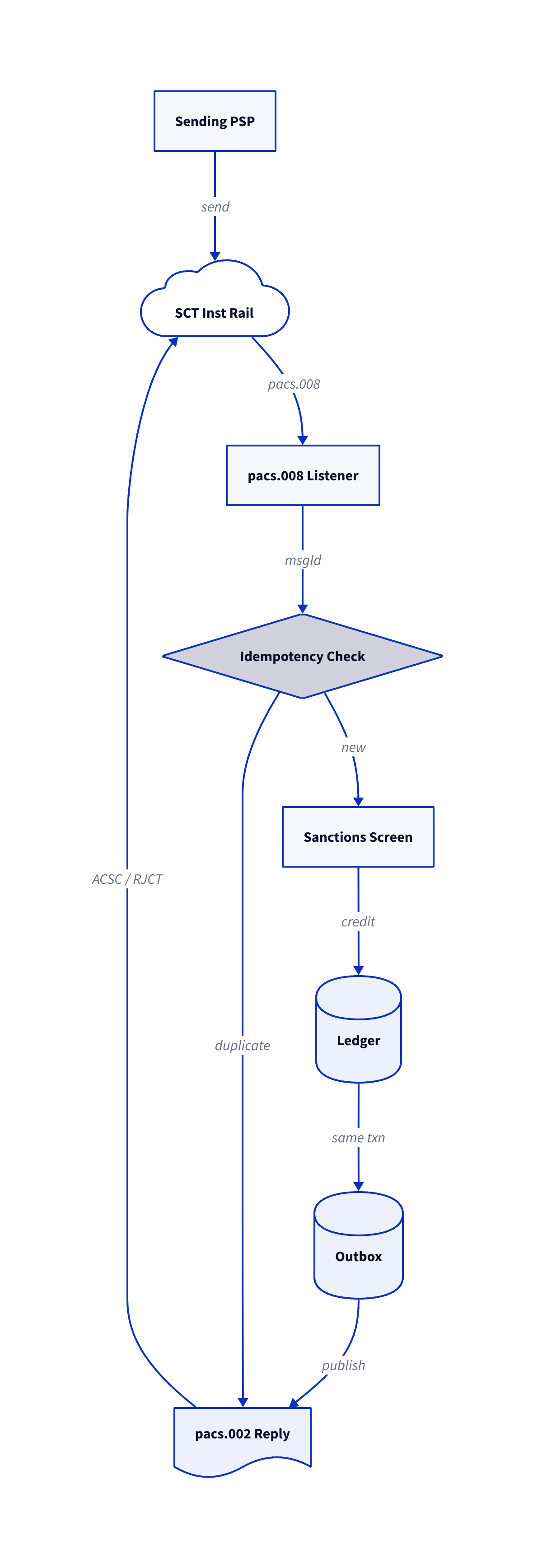
Clearing systems retry. Your own load balancer retries. A pod restart mid-processing means the same pacs.008 shows up again. The identity of a payment on this path is the interbank message ID carried in the pacs.008 group header (MsgId), together with the instruction ID so batch edge cases do not collide. That is what you key on, not a UUID you generate on arrival.
The rule I enforce: one interbank ID, exactly one terminal decision, and a replay returns the stored decision. If a duplicate arrives while the first is still in flight, the second waits briefly for the first, it does not start a parallel credit. I have written the general pattern, with the inbox table and consumer side, in Transactional Outbox and Idempotent Consumers for Payment Systems, so here is only the receive-specific shape.
@Repository
class InboundPaymentStore {

    private final JdbcClient jdbc;

    InboundPaymentStore(JdbcClient jdbc) {
        this.jdbc = jdbc;
    }

    /** True if this call won the right to process; false if the ID was already seen. */
    boolean claim(String interbankMsgId, String instrId) {
        int rows = jdbc.sql("""
                INSERT INTO inbound_payment (msg_id, instr_id, state, received_at)
                VALUES (:m, :i, 'IN_FLIGHT', now())
                ON CONFLICT (msg_id, instr_id) DO NOTHING
                """)
            .param("m", interbankMsgId)
            .param("i", instrId)
            .update();
        return rows == 1;
    }

    Optional<StoredDecision> decisionFor(String interbankMsgId, String instrId) {
        return jdbc.sql("""
                SELECT state, reason_code FROM inbound_payment
                WHERE msg_id = :m AND instr_id = :i
                """)
            .param("m", interbankMsgId)
            .param("i", instrId)
            .query((rs, n) -> new StoredDecision(rs.getString("state"), rs.getString("reason_code")))
            .optional();
    }
}
The unique constraint, not application logic, is what protects you. Two pods racing on the same ID both run the insert and the database picks one winner.
The listener, the credit and the outbox-backed pacs.002
The reply is where people get hurt. If you credit the ledger and then crash before sending the pacs.002, the sender sees a timeout and refunds the payer, while your customer also holds the money. That is a real loss with a real reconciliation case. The fix is to make the ledger credit, the decision record and the reply message one local transaction: write the pacs.002 payload to an outbox table in the same commit as the credit, and let a relay publish it.
@Service
class SctInstReceiver {

    private static final Duration TOTAL_BUDGET = Duration.ofMillis(4_000);

    private final InboundPaymentStore store;
    private final ScreeningGate screening;
    private final FxCreditPlanner fx;
    private final LedgerClient ledger;
    private final Pacs002Outbox outbox;
    private final TransactionTemplate tx;

    // constructor omitted for brevity

    void onPacs008(Pacs008 msg) {
        Deadline deadline = Deadline.fromNow(TOTAL_BUDGET);

        if (!store.claim(msg.msgId(), msg.instrId())) {
            replayStoredDecision(msg);   // duplicate: same answer, never a second credit
            return;
        }

        Decision decision;
        try {
            decision = decide(msg, deadline);
        } catch (DeadlineExceededException | UpstreamUnavailableException e) {
            decision = Decision.reject(RejectReason.TIMEOUT);
        }

        Decision finalDecision = decision;
        tx.executeWithoutResult(status -> {
            if (finalDecision.accepted()) {
                ledger.credit(finalDecision.creditPlan(), msg.msgId());  // same DB transaction
            }
            store.markTerminal(msg.msgId(), msg.instrId(), finalDecision);
            outbox.enqueue(Pacs002.from(msg, finalDecision));
        });
    }

    private Decision decide(Pacs008 msg, Deadline deadline) {
        Account acct = ledger.findAccount(msg.creditorIban(), deadline.slice(Duration.ofMillis(150)));
        if (acct == null) return Decision.reject(RejectReason.UNKNOWN_ACCOUNT);
        if (!acct.isOpen()) return Decision.reject(RejectReason.CLOSED_ACCOUNT);
        if (acct.isBlocked()) return Decision.reject(RejectReason.BLOCKED_ACCOUNT);

        ScreeningOutcome s = screening.check(msg, acct, deadline.slice(Duration.ofMillis(800)));
        if (s.blocked()) return Decision.reject(RejectReason.REGULATORY);

        CreditPlan plan = fx.plan(msg.amountEur(), acct, deadline.slice(Duration.ofMillis(300)));
        if (deadline.expired()) throw new DeadlineExceededException();
        return Decision.accept(plan);
    }
}
An in-flight row that never reaches a terminal state, because a pod died, must be swept by a job that sends a reject for it. Otherwise the sender waits for you and you never answer.
The outbox relay is boring on purpose: poll with SELECT ... FOR UPDATE SKIP LOCKED, publish to the network adapter, mark sent. Sending a pacs.002 twice is harmless if your message ID on the reply is stable, so the relay can be at-least-once.
Mapping rejects to pacs.002 reason codes
Rejecting is a decision, and the reason code is part of the answer. A wrong code turns a clean reject into a support ticket on the sender's side. The enum above maps onto the ISO 20022 external status reason codes like this. Verify each against the current SCT Inst rulebook and your CSM's usage guide, since schemes restrict which codes are allowed:
| Internal reason | Code | Meaning |
|---|---|---|
UNKNOWN_ACCOUNT | AC03 / AC01 | Invalid creditor account number, check which your scheme prefers |
CLOSED_ACCOUNT | AC04 | Account closed |
BLOCKED_ACCOUNT | AC06 | Account blocked for credits |
REGULATORY | RR04 | Regulatory reason, including sanctions hits |
TIMEOUT | AB05 | Timeout at the creditor agent |
| Core or CSM link down | AB08 | Creditor agent offline |
| Duplicate detected as non-replay | AM05 | Duplication |
| Customer deceased | MD07 | End customer deceased |
Note that AM04 (insufficient funds) belongs to the sender side and never appears in a credit reject from you. A related trap: do not put the real sanctions reason in the free-text field. RR04 alone is enough, and detail about a screening match must not leak to the counterparty.
Liquidity and settlement: receiving is not only crediting
Everything above assumes the money has actually arrived. For an instant payment, the legal and the technical picture are separate. Your service answers a pacs.002 in seconds, but funds move between PSPs through settlement in the CSM, typically against an account that must hold enough liquidity. Three things belong in a receive-readiness plan:
- Settlement position. If you use a TIPS-style scheme with a dedicated cash account, your position in the system changes with each payment. When you are mostly a receiver, your balance there grows, and someone has to sweep it back to your central bank account on a schedule, including weekends. If you are net sending, the account runs down and a top-up must land before the next burst. Wire the funding job to the same 24/7 calendar as the payments, because a funding job that only runs on TARGET business days does not match a scheme that never closes.
- Reachability. Your BIC or participant ID must be reachable in the CSM directory, and a technical reachability outage (your adapter, your certificates, your link) is an availability event that you need alerts on. The AB08 case above is how it looks from outside.
- Reconciliation. Match the settlement report from the CSM against your own accepted-payments table at intervals during the day, not once at close. Any payment you accepted but the CSM shows as rejected or timed out is the exposure from the section on the reply path.
Sanctions screening inside the budget
Screening is the stage most likely to blow the clock, and the question people argue about is whether you screen each payment at all.
My reading of Article 5d, added by the regulation, is that for instant credit transfers it replaces per-transaction sanctions screening with daily screening of your own customer base against the EU's restrictive-measures lists, at least once each calendar day, plus promptly when lists change. I got this from one secondary source and could not confirm it in a second, so I treat it as unverified, and I cannot give you legal certainty from a blog post. Read the article text yourself and get your compliance function to sign the interpretation. Your national regulator, or your own policy for third-country or higher-risk flows, may still call for transaction-level checks.
So I do not hard-code either answer. I make the gate a strategy and choose per policy:
interface ScreeningGate {
    ScreeningOutcome check(Pacs008 msg, Account creditor, Duration timeLeft);
}

@Component
class DailyListGate implements ScreeningGate {
    private final CustomerListMatchCache cache;   // refreshed by a daily + on-list-change job

    public ScreeningOutcome check(Pacs008 msg, Account creditor, Duration timeLeft) {
        // Nothing remote on the hot path: a lookup of a precomputed flag.
        return cache.isFlagged(creditor.customerId())
                ? ScreeningOutcome.blocked() : ScreeningOutcome.clear();
    }
}
A transaction-level variant calls the screening engine with a client timeout equal to timeLeft. When it times out, you must choose a failure policy up front: fail closed (reject, safe for compliance, annoying for customers) or fail open with post-credit hold (credit, then freeze funds and review). I default to fail closed for any hit above a score threshold and for timeouts on high-risk corridors, and to credit-then-review otherwise. What matters is that someone decided this in a design review, not at 3 a.m. in an incident.
FX-aware crediting: the problem euro-zone content ignores
A euro-zone bank credits euro into a euro account. You will often credit euro into a PLN, RON, SEK or CZK account, or into a euro sub-account if you offer one. That adds a conversion on the critical path, and an obligation: under EU rules on cross-border payments, conversion charges and disclosure to the customer still apply, so the rate you use must be explicable afterwards.
My approach is a rate snapshot with tolerance:
@Component
class FxCreditPlanner {

    private final RateSnapshotCache rates;   // refreshed every second by a separate feed
    private static final Duration MAX_AGE = Duration.ofSeconds(5);

    CreditPlan plan(BigDecimal amountEur, Account acct, Duration timeLeft) {
        if (acct.currency().equals("EUR")) {
            return CreditPlan.direct(acct.id(), amountEur);
        }
        RateSnapshot snap = rates.latest(acct.currency());
        if (snap.age().compareTo(MAX_AGE) > 0) {
            throw new UpstreamUnavailableException("stale FX snapshot for " + acct.currency());
        }
        BigDecimal local = amountEur
                .multiply(snap.customerRate())
                .setScale(acct.minorUnits(), RoundingMode.HALF_EVEN);
        return CreditPlan.converted(acct.id(), amountEur, local, snap.id());
    }
}
Three rules sit behind that small class. The conversion never calls a live pricing service in the hot path; a separate feed fills the cache. The snapshot ID is stored with the credit, so a customer complaint can be answered with the exact rate and time. And a stale snapshot rejects instead of guessing, since a wrong rate on a payment you cannot reverse is worse than a rejected one the sender can retry.
If you hold a euro account for the customer, offer crediting there by default and conversion on the customer's instruction. That removes the stage from the clock entirely for those accounts.
24/7/365: availability is the real deliverable
Instant means no batch window and no "the core is down for the nightly run". I treat the following as the minimum:
- Decouple the receive path from the core ledger's batch cycle. If your core banking system has an end-of-day freeze, put a shadow ledger or a reserve account in front: credit there in real time, post to the core later. Reconcile on a schedule. The reconciliation mechanics are the same ones I used in a dual-ledger Spring Boot stablecoin backend.
- Run at least three replicas across two zones, with the consumer side stateless. All state lives in the database, so any pod can take any message.
- Rolling deploys only. Drain a pod by letting in-flight work finish; the sweep job above catches the one that did not. I covered the schema side of never stopping in zero-downtime database migrations with Flyway.
- Measure the right thing. The SLO is not average latency but the share of messages answered inside budget. Track p99 and p99.9 per stage, and alert on budget consumption, not on CPU. Good tracing makes this practical; see distributed tracing with OpenTelemetry in production.
Degradation matrix
When something is slow or down, the listener needs a pre-agreed answer. Mine:
| Dependency state | Behaviour |
|---|---|
| Idempotency DB unreachable | Reject with technical reason; never process without the claim |
| Core ledger slow or in freeze | Credit shadow ledger if enabled, otherwise reject |
| Screening engine slow | Per policy: fail closed on high risk, credit and hold otherwise |
| FX feed stale | Reject for non-EUR accounts, accept for EUR accounts |
| Outbox relay down | Keep accepting; replies queue durably and drain on recovery |
| CSM link or settlement account problem | Alert immediately; the sender sees AB08 or a timeout |
| Whole region lost | Fail over; duplicates are safe because of the claim table |
That table is the artefact I would show a supervisor. It proves you thought about every failure and chose, rather than found out. If you are in DORA scope, the same table doubles as resilience evidence; I show how to keep that evidence in version control in DORA and NIS2 as code for Spring Boot.
Leaving room for 9 July 2027
Sending and Verification of Payee arrive six months later, and the receive design should not paint you into a corner. Three seams to leave now:
- Keep the pacs.008 model direction-neutral. Build your domain types so the same classes serve outbound, rather than naming everything
Inbound. - Reserve a pre-send hook for name verification. Verification of Payee is an outbound check before the payer confirms. The matching logic and fraud-liability angle are in my post on IBAN-name verification and liability under PSD3/PSR. As a receiver you will also need to answer verification requests from other PSPs, which is a separate low-latency endpoint with its own, shorter budget. If you already expose account endpoints, PSD2 API development covers the neighbouring consent and security model.
- Share the deadline and outbox primitives. The
Deadlineclass and the outbox relay work equally for sending; only the state machine differs. The same primitives also fit mandate-based flows such as commercial VRP.
Address formatting is adjacent but separate: unstructured postal addresses leave SEPA ISO 20022 messages from 15 November 2026. If your parser is still tolerant of free-text addresses, handle that with the validator I describe in the ISO 20022 structured address post.
What I would test first
Given the thesis, my test plan is about time and failure, not XML:
- Load at 3x expected peak with a synthetic pacs.008 generator, measuring the fraction answered inside the 4-second internal budget.
- Lock contention: run the core's end-of-day batch while the generator is running and record how many credits breach the ledger cap.
- Chaos on each dependency: add 2 seconds of latency to the screening engine and confirm the matrix behaves as written.
- Duplicate storms: send each message five times concurrently and assert one credit.
- Kill -9 mid-transaction, then confirm the sweep produces exactly one reject or one accept for every in-flight row.
- Midnight and DST: run across the clock changes and the Sunday-night core freeze, since those are where "24/7" quietly breaks.
My background is in high-volume systems, from 130 million requests a day at AirAsia to live market-data pipelines where a late answer is a wrong answer. That experience points in one direction: the message format is a solved problem, and the clock is not.
Your next step
Open your current payment-receiving design and write one page this week: the stage-by-stage millisecond budget from the table above, filled in with your own measured p99 numbers, and the degradation matrix with an owner's name beside every row. Whichever row has no answer is where you start building. If you want a second pair of eyes on it, reach me through the contact section.
FAQ
What is SEPA Instant (SCT Inst)?
SCT Inst is a euro bank transfer that reaches the receiver's account within seconds, at any hour of any day. The whole transfer has a hard time limit of 10 seconds, and money that cannot be credited in time is sent back.
What changes for non-euro EU banks on 9 January 2027?
Banks in EU countries that do not use the euro, such as Poland, Romania, Sweden and Czechia, must be able to receive instant euro transfers for their customers' accounts. Sending those transfers, and checking that the name matches the account, follows on 9 July 2027.
Why is the 10-second limit an engineering problem?
Every step, from reading the message to checking sanctions and crediting the account, must finish inside one shared time budget, and it must work every minute of the year. A slow database or a restart during that window means a rejected payment.
What is a pacs.002 message?
It is the reply the receiving bank sends back for each incoming payment, saying either accepted or rejected with a reason. The sender and the payment network wait for that reply.
Why must receiving an instant payment be idempotent?
A clearing system or your own load balancer can hand you the same pacs.008 twice, and the customer must still be credited only once. The unique key on the interbank message ID makes the second delivery return the stored answer instead of moving money again.